OEM Replacement Coils: Repair or Replace

When considering OEM replacement coils, there are multiple reasons why coils can fail prematurely. Sometimes, OEM Coils simply freeze and can never be repaired. Other times, the coil was selected incorrectly, which in turn, made the coil significantly underperform. Many times, there is substantial corrosion or something else in the system that causes the coil to fail. However, most coils, when selected correctly, and in systems that are properly maintained, can last anywhere from 10-30 years!  10-30 years is also a pretty wide range, and there are many variables in how long you can expect a coil to perform. Factors, such as ongoing maintenance, air quality, and water/steam quality all have an effect on a coil’s lifespan.
OEM Replacement Coils

Reasons Why Coils Fail Of Old Age

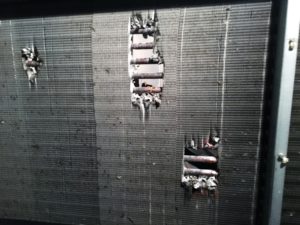
  • While the coil’s tubes are considered the primary surface, 70% of all coil performance is performed by the finned area on a coil, which is known as the secondary surface. The fin/tube bond is easily the most important manufacturing feature in any coil. Without the bond between the tubes and fins, the coil could never properly function. Like all things however, over time the fin/tube bond becomes less efficient with constant expansion and contraction. While the construction of the coil, as well as the fin collars, does not allow the fins on the coil to move, that fin/tube bond naturally weakens a coil’s life over time after installation. Because of this, it is not a stretch to say that a coil is easily 30% less efficient after (20) years.
  • Cleaning coils often pushes dirt to the center of the coil, and this occurs even more so on wet cooling coils. Just remember that coils can become great air filters if not properly maintained. The BTU output of any coil is in direct proportion to the amount of air going through the coil. If you decrease the CFM by 20%, you are also decrease the BTU’s by 20%!
  • Cleaning agents often corrode aluminum fins. Since every square inch of fin surface matters in performance, corrosion of the fin surface is always detrimental to the coil’s performance.
  • Many times, there are coil leaks simply because of old age. No coils are immune to erosion. You might find the brazing in the tubes, as well as the brazing in the header/tube connections failing over time. Steam can be both erosive and corrosive under higher pressures. Water travels through the coil at 2 – 5 ft/second, so erosion is an enormous part of coil failure, regardless of how well-maintained. Erosion is always there, whether you realize it or not.
  • Water/steam treatment and the corrosive effects of bad steam/water can all be causes of coil failure…which then necessitates the need for a reliable manufacturer for OEM replacement coils.

So What Is The Solution?

Some coils can last 5 years, and some coils can last 30 years. As you have read, there are numerous factors that contribute to a coil’s life. In the end, there will most likely have been multiple attempts to repair that coil to make it last as long as possible. The depressing news is that most of these “Band-Aid” attempts do not work well. The most likely outcome is that you are buying a new coil anyway, so why waste the time and money on a temporary solution?

Coil failure is a “pressure event”, which is a fancy way of saying that a coil is leaking. We’ve listed some of the most common repair methods that you are likely to come across:

  • Drop leaking tubes from the circuit: Keep in mind however that every dropped tube reduces the coil’s performance by triple the surface area of the tube that is dropped. Again, while ok in the short-term, this is simply another “Band-Aid” fix. Over time, your energy costs will rise exponentially, and you will probably end up buying a new coil anyway.
  • Braze over the existing braze: As mentioned above, erosion has caused the original braze to fail, so all that you are really doing is pushing the pressure to another braze, which will then begin to fail as well.
  • High Pressure Cleaning: This method bends the fins, further restricts the airflow, and pushes dirt more to the center of the coil, which can never be adequately cleaned.

The real reason why coils need to be replaced rather than repaired is due to energy costs. If your coil is not operating near desired levels, you’ll need to increase the energy to make it work at its peak performance. Energy increases might be slight at first, but they are guaranteed to continue to rise over time. For example:

  • Somebody adjusts the fan drive for higher speeds, higher CFM’s and higher BTU’s.
  • Someone adjusts the boiler; the water and steam temperatures are higher.
  • Someone adjusts the chiller (1) degree higher for colder water to the chilled water coil.

Whichever method is used, performance begins to suffer and adjustments to the system occur. These adjustments cost energy efficiency and ultimately, money!

If you have ever experienced repairing a coil, then you know it is labor intensive and typically will not work as a permanent solution. With very few exceptions, repairs should be seen as nothing more than temporary until you’re able to replace that coil!

Capital Coil & Air has seen every “repair” method used, as well its inevitable outcome, so instead of putting yourself through that, call Capital Coil and allow us to be your coil replacement experts.

RELATED POSTS

Is Your Quick-ship Shut Down When Needed Most??

Four Things That You Need When Buying Replacement Coils
Replacement HVAC Coils: 10 Common Ordering Mistakes

Top 5 Reasons HVAC Coils Prematurely Fail


How to make your HVAC OEM Replacement Coil Buying Process Easier??

Roughly 100% of HVAC OEM replacement coil shipments use some kind of trucking company or common carrier. There are occasions when the shipment is small enough to use UPS or FedEx, but the vast majority of HVAC shipments are sent by way of truck. Anyone who has frequently used freight companies has experienced damaged shipments and/or late arrivals. In our industry, these annoyances and inconveniences are typically written off as “the cost of doing business”. Think of the airline industry as an example. Our expectations have been reduced to point where we expect something to go wrong and are pleasantly surprised when the trip is smooth from start to finish.

Many folks might not know this, but even before the pandemic struck, the trucking industry in general had been experiencing a gross shortage of drivers throughout the country. Some estimates have put this shortage of drivers as high as 50,000 throughout the country.

So what does this shortage mean for the HVAC industry? Put simply, it translates into complications and confusion for all involved.

  • Longer delivery times. For example, a delivery that used to take (3) days is now (5-7).
  • One major reason for the longer delivery times is that trucks now have many more stops than in years past. There are also many instances of more trips through connecting terminals as well.
  • More time on the truck usually equates to both “visible” and “hidden” freight damage.
  • The shipments become harder to track, and with fewer people at the trucking companies doing more work, shipments can and will get lost entirely.

Because the freight process is at the very end of the OEM replacement coil buying cycle, Capital Coil & Air has developed some simple strategies for the entire buying process that should help in avoiding many of the annoyances listed above. We’ve also added a very useful “hint” to counter longer freight delivery times.

  • Getting a price, delivery & accurate proposal from your vendor: Capital Coil responds to every quote request quicker than any of our competitors, and we are always willing to put that claim to the test. A (2) day delay in receiving your quote is the same as a (2) day freight delay on the back end.
  • Receiving your submittal drawings in a timely fashion: You need to approve these drawings, so once again, how is a (2) day delay in receiving approval drawings any different than receiving your order (2) days late?
  • Quick-Ships: As you’ve probably experienced numerous times in the past and/or present, other coil manufacturers seem to be consistently shutting down their quick-ship programs with little to zero notice for the customer. Why is this? Many manufacturers take on a glut of OEM replacement coil business, or other large projects with small profit margins. In many cases they do this simply to keep the factory running during the slower periods of the year. This has the effect of delaying standard lead times, and in many cases, cancelling quick-ships altogether. It is very hard to do business with companies that make themselves unavailable when you need them the most.

Capital Coil NEVER shuts down our quick-ship programs, and we emphasize NEVER! Over the last (2) years, CCA has hit approximately 99% of all quick-ship orders.

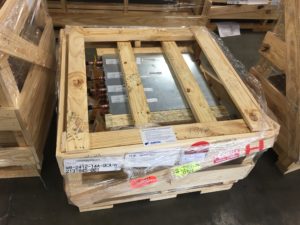
  • Crating equipment to minimize freight damage.OEM Replacement Coil
  • Shipping on time: Simply put, we consistently ship when we say we’re going to ship.
  • Select a freight carrier that delivers to your area without interlining or stopping at several terminals: This is when freight damage is most likely to occur!
  • Pay the carrier fee for a guaranteed delivery date: Although seemingly not well-known, most carriers offer a guaranteed delivery date for a fee of $50-$100. Paying the fee will ensure that your order is now a “priority”, and most freight companies schedule deliveries based on these “priorities” first. If both your order and delivery are critical and time-sensitive, Capital Coil can help you with exploring these delivery options.

Capital Coil & Air will work with you throughout the entire buying and shipping process because you as the customer, deserve to work with a hands on manufacturer that will not turn its back on you once the order has been placed. Please give Capital Coil a try on your next project!

RELATED POSTS

Quick-Ship Fan/Coils & Light Duty Air Handlers

Quick, Reliable & Uncommonly Fast

Top 10 Tips to Measuring Coils


Case Study: We Need These Coils on a (5) Day Quick-ship

In late June, Capital Coil received a call from a Trane office in Ohio regarding quick-ship availability. One of Trane’s top customers had an urgent need for (12) large chilled water coils with stainless steel casing. The problem/hurdle that they were encountering was that they needed all (12) coils to be built and ship out of the factory in (5) business days. Completion of the whole project was 100% contingent on them receiving the coils in their specified time-frame. An additional complication was the fact that July 4th was the following week, and they needed to have the coils ship prior to the holiday.

Trane shopped the project around to different manufacturers, but not one could guarantee to ship in (5) days. Some manufacturers waffled and claimed that they could have them built in (6) or (7) days, but not one could guarantee to ship in (5) days. A sales rep in that same Trane office, who had worked with Capital Coil previously, suggested that his co-worker reach out to us to see what we could do. After speaking with Trane’s project manager, we immediately contacted our head of production to make sure that we had the capacity to complete all (12) coils in the required (5) days. She assured us that we had the materials and manpower on-hand to get them all built and ship on time. We agreed to accept the project and began work on the coils immediately.

Due to the size of the project, as well as it’s time-sensitivity, we had multiple calls daily with our factory to ensure that everything was proceeding on schedule. We then gave Trane daily status updates, so they were constantly informed of everything from the brazing of the coils to entering the final testing phase. Chilled Water Coil

As promised, all (12) coils were built correctly and shipped out in the required (5) days. Our logistics team was then in constant communication with the freight company to make sure that the delivery was on schedule. And just like during the production phase, we passed daily tracking updates along to Trane, so they knew where their coils were at all times and when they could expect delivery. All (12) chilled water coils arrived on July 3rd with zero freight damage, and the project was completed on time!

A company as large and influential as Trane can have their coils built by anyone, but Capital Coil was the only manufacturer that could guarantee to have their coils built and shipped by a required date. Additionally, in working so closely with Trane throughout the whole process, they were kept up-to-date in real time from the start of production to final delivery.

Capital Coil offers a level of service that you won’t get with other manufacturers. When we guarantee to ship by a certain date, we stand by that guarantee, or you do not pay!


Trane’s project manager’s comments to Capital Coil upon completion/delivery:

“This will help us get a jump on this project prior to the big event taking place next week! 

I will make sure to share your information with others across our great lakes region about our experience with your company, so that they know we have THIS option to go to for our coil needs. THANK YOU ALL!!”


Why Are Fin Designs On HVAC Replacement Coils Important?

Replacement HVAC Coils

At first glance, fin designs on HVAC replacement coils seem about as exciting as watching grass grow. “Why would I ever care about fin designs on any coil” was probably your initial response to our question. Nevertheless, we would not dedicate a newsletter to this subject if fins were not important.

One of the primary reasons fins are so important is that you want to keep your coil as clean and maintained as possible. In order to properly maintain your coil, you need to have an understanding as to how HVAC replacement coils are constructed. While fins do not look like much, they are MUCH more complicated than what you can observe at the entering or leaving airside of the coil.

To begin, fins are responsible for a surprising 65% – 70% of the heat transfer on any coil, while tubes are responsible for the remaining 30% – 35%. Additionally, in order for your coil to work at optimum performance, you need to have a terrific fin/tube bond, (which we will discuss below).

  1. Fins are known as secondary surface, while tubes are referred to as primary surface. While this may seem counter-intuitive, the secondary surface is responsible for twice the amount of heat transfer as the primary surface.
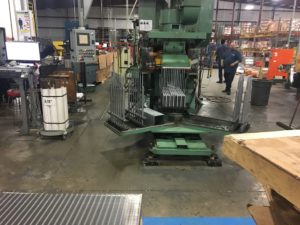
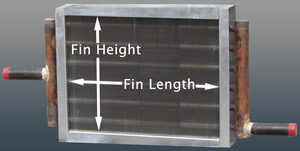
  2. There are special dies (see picture) that stamp out aluminum or copper fins with the correct thickness, height, and depth to make the coil the correct size. For example, a coil might be 36” (height) x 96” (length) x (8) rows deep x 8 fins/inch.
    1. Fin Height: 36”
    2. Fin Depth: 12”, (8) rows deep
    3. # of fins in the coil: 768 (8 fins x 96”)
  3. Each fin has 192 holes stamped in the fin for 5/8” OD tubes (8 Rows x 24 Tubes), and each fin is identical.
  4. Each hole has extruded metal, which is more commonly referred to as the fin collar. The collars are sized to self-space the fins and allow for later expansion of the tube into the fin collar. This practice is also known as “bonding” and is essential to having your coil run efficiently/correctly.
  5. Each fin is rippled at the entering and leaving edge of the fin to help create air turbulence.
  6. Each fin is corrugated in the direction of airflow to allow for greater air turbulence. This is important to remember because turbulence creates heat transfer.

So again, what is the point of understanding the importance of fins in HVAC coils? While coils can be built with flat fins for various reasons, the vast majority of coils are built with enhanced fins. Enhanced fins help to ensure that the airflow is not running straight through the coil.

Regardless of fin type, keep in mind that HVAC coils can and will act as great “filters”. The tubes are staggered and not in-line; while the fins are designed to help break up the airflow and not facilitate an easy, straight-through air path. Dirt and/or other particles in the air get caught easily, which again, is why coils can act as great filters. Additionally, coils with more rows will usually get dirtier than coils with less rows. Lastly, chilled water or DX coils are typically wet coils, which results in them catching virtually everything in the air.

The amount of BTU’s through any coil is in direct proportion to the amount of air through the coil. For example, if you are only getting 90% of the design air through the coil, then you are only getting 90% of the BTU’s.

Coils require good filtration and periodic maintenance. If not done correctly, you’ll pay the price of higher energy costs on an inefficient coil.

By now, you have hopefully come to the realization that HVAC coils are much more complicated than they appear, and that fins are an integral part of the coil as a whole. Again, while admittedly not the most exciting topic, understanding the role and importance of fins in HVAC coils cannot be overstated. Capital Coil & Air is here to help you with any and all coil selections, and we look forward to working with you on your next project.

RELATED POSTS

Repair or Replacement Coils?

Top 5 Reasons HVAC Coils Prematurely Fail

Are You Asking Your Coil Supplier These Questions?


Hot Water Coils & Heating Season

The real ability and competency in selecting hot water coils or any other heating coil is to know and understand the products that are available. Our goal here is to help simplify your selection process. Just as you’d spend time researching cars before a purchase, you want to be as educated of a buyer as possible!Hot Water Coil

HOT WATER COILS

The HVAC industry classifies coils as “Hot Water” if they are (1) or (2) rows deep, and “Chilled Water” if the coil is (3) to (10) rows deep. One important fact to remember is that whether the water is hot or cold, a water coil is still just a water coil. Just because you do not need as many rows for hot water applications, all water coils are built the same. Tubes can be 5/8 ” copper or 1/2 ” copper, and water can travel through the coil’s tubes at temperatures up to 200˚F. Capital Coil’s selection program is very user-friendly and can greatly assist in your selection process.

STANDARD STEAM COILS

While steam coils look very similar to water coils, the construction and circuiting of the coil are usually very different. Specifically, the brazing for the tubes and headers has a higher percentage of silver solder in the brazing. The tubes are generally thicker (.025”), and the circuiting of the coil minimizes the passes to allow for easy condensate removal. Unless you have (2) PSI or (5) PSI steam, hot water coils and steam coils are not interchangeable! Steam pressure is extremely important to take into account.

STEAM DISTRIBUTING COILS  “NON-FREEZE”

The construction of a “non-freeze” coil is completely different than that of a water coil or standard steam coil. Steam Distributing coils are manufactured as a tube within a tube. This application should always be used when the entering air temperature on a coil is 40˚F or below. There are (2) types of designs for steam distributing coils. They can be constructed with 5/8” (outer-tube) / 3/8” (inner-tube)  &  1” (outer-tube) / 5/8” (inner-tube).  A Capital Coil sales rep is always available to help with proper selections.

HOT WATER BOOSTER COILS

Hot water booster coils are primarily used in duct applications for reheat purposes. In addition to hot water, booster coils can also be used for low pressure steam. The best part is that Capital Coil has a standard (1) week lead time for booster coils. We value speed and quality as much as you.

Capital Coil manufactures all of the above for whatever heating application you may need. All coils are also available on our quick-ship program – if you need your coil built in 3, 5, or 10 days. Capital Coil & Air welcomes the chance to work with you, and be your source for quick answers and immediate service. Please give us a call on your next project!

RELATED TOPICS

Stock Hot Water Booster Coils

Booster Coils: Quick Buyer’s Guide

Commercial Steam Coils – Lengths & Controls


Are Your Quick-Ships Shut Down When Needed Most???

Why are quick-ships so important??

Christmas season is in full-swing, and your current coil supplier has suspended all Quick-Ships with little to zero notice to its customers. Does that sound familiar these days? Additionally, the clock is ticking to complete those projects that need to be done by the end of the year. In this industry, this scenario is when “Quick-Ship” availability is an absolute must. Right now, the vast majority of coil manufacturers are scrambling to complete standard orders on regular lead-times, and if by dumb-luck they are able to temporarily offer any type of expedited build, the added premiums are so astronomical that very few customers can afford to use those options.

If you need a new coil, your first inclination will probably be to call the OEM. But more times than not, they are not flexible or nimble enough to handle your emergency within an acceptable time-frame. Quick-ships are generally based on emergency conditions, and that is precisely the worst time to discover that your regular supplier has suspended Quick-Ships.

So why do so many manufacturers seem to get so overwhelmed at various point every year? In short, many manufacturers take on a glut of OEM business, or other large projects with small profit margins. In many cases they do this simply to keep the factory running during the slower periods of the year. This has the effect of delaying standard lead times, and in many cases, cancelling Quick-Ships altogether. It is very hard to do business with companies that make themselves unavailable when you need them the most.

Capital Coil’s primary duty as the leading OEM replacement coil manufacturer is to fill in those gaps and work with you to help alleviate any emergencies. Whether you need a coil in (3) weeks, or (5) days, Capital Coil has got you covered.

Capital Coil does not try to be all things to all customers, and we’re most comfortable “staying in our lane”. Our #1 goal is to ensure that we have multiple quick-ship options open all year around…even if that means turning away an order to ensure sure that our Quick-Ships are ALWAYS available!!  Quick-ships

Because Quick-Ships make up such a substantial portion of our overall business, Capital Coil has hit 99.9% of our quick-ship requests over the last (2) years. An unfortunate forklift mistake makes up the other .1%. Throughout the first 6 months of 2022, approximately 80% of all orders were/are quick-ships, and they have either all been completed on time, or are 100% on schedule.

An RFQ that sits on a desk unanswered is useless to everyone involved. If you need a quote, you’ll have your price and any required submittals that same day. It really is that simple and easy! Working with Capital Coil will remove many, if not all of the annoying and unannounced shut-downs that come with other manufacturers, so please let us help you when you need it the most!


RELATED POSTS

Uncertain About Recent Changes In The HVAC Industry?

Repair or Replace Your HVAC Coils?

10 Things You Need to Know to Buy Replacement Coils Effectively


Do You Need to worry about performance on replacement HVAC coils?

With replacement HVAC coils, performance is almost never the issue. This is a common mistake that a lot of folks make. When duplicating a coil, your efforts need to be directed towards making sure the coil fits correctly, as that’s usually the main issue. While you may be thinking that doesn’t make a whole lot of sense, here are the main reasons:

  • Coils were never intended to be filters, but that’s exactly what they become over time. For those that routinely work with coils, you know its design is tailor-made for the collection of dirt and Water Coilother air particles The tubes are staggered, which means that dirt can not get through. The fins are rippled and corrugated, which typically leads to the same result. Wet coils tend to collect more dirt than dry coils. The process of cleaning coils is very difficult, and the deeper the coil, the more difficult it is to clean. The end result, depending on the age, maintenance and operation, means that your coils operate anywhere from 50%-70% of their maximum efficiency.
  • Fins do approximately 70% of the work in a coil, with the tubes making up the remaining 30% (generally). When manufactured, the tubes are expanded into the fin collars. But, over time, the fins tend to loosen a little. While not sliding back and forth, the fins lose efficiency and their performance is lessened.
  • So what’s your typical solution after 5, 10 or 15 years? You’d probably raise or lower the water temp on you coil. You might also speed up the drive to get more CFM across the coil. You’ll try most anything to make up for the loss of the coil’s efficiency. Everybody does.
 

But when you replace the coil, it’s new and clean. Additionally, with a new fin/tube bond, your new coil is operating at 100% efficiency, while the old coil was working at 60% – 70% efficiency…maybe. With this automatic increase in efficiency means that performance is not really the issue. Your main concern should be that the coil fits in the space available. Otherwise, your new coil is nothing more than an ugly, metallic coffee table.

Your main goal is to replace your coils with as little trouble and cost as possible. While you may still have offsets in piping, as well as other small installation adjustments, performance should be the least of your worries. We’re here to help you meet your requirements quickly and easily.  CALL OR E-MAIL US!  We look forward to the opportunity to work with you on your future projects.

 
Replacement HVAC Coils

RELATED POSTS

Construction Vs Performance: Need To Know Terminology

Tips on Hand Designation & Counter-flow

Four Things That You Need When Buying Replacement Coils
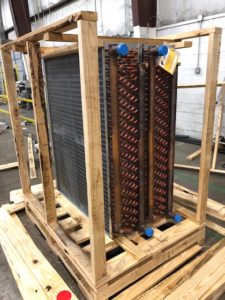

Light-Duty Commercial Belt Drive Air Handler Units

There are lots of jobs that require large custom built Air Handler Units, as well as jobs that require Central Station Air Handler Units that are semi-custom built units. There are also plenty of jobs that Belt Driverequire neither of the above products. This application only requires that a light-duty standard unit be built that will match the duty and requirements of the job.

 Examples

  • Strip Malls/Shopping Centers
  • Dormitories and other college campus buildings
  • Military installations
  • Office areas in factories or other industrial settings
  • Condominiums

These examples do not need large heavy-duty units that are expensive and custom built. Instead, most of these units require standard light-duty construction that can provide 800-12,000 CFM. These units come with various options and choices, and are well-built with the highest quality components available. However, the units are not designed for overkill.

Capital Coil manufactures “Belt Drive” units that operate from 800 CFM (2 Tons) – 12,000 CFM (30 Tons). They are available in both horizontal and vertical airflow styles. Included are blowers, coils, drives, filters as well as additional accessories if required. Additionally, they are available in Chilled Water Coils, DX Coils, Hot Water Coils, and electric heat if needed.

So, why would you want to use these units in lieu of a heavy-duty air handler? Cost, cost, and cost again are the primary reasons. In addition, the light-duty units weigh less, they are more economical to install, and long-term maintenance is much easier. The overall cost of a Custom-Built Unit or a Semi-Custom Station Unit is dramatically higher and not needed in most installations. Please visit Capital Coil’s Belt Drive Product Page for additional descriptions of our units.

Shipping Schedules

  • Standard lead time: (6) weeks
  • (4) week quick-ship: 30% adder
  • (2) day quick-ship: 40% adder

Capital Coil is 100% transparent on all prices and pricing options. Each option is clearly listed on all quotes to help make your buying experience that much easier.

The Air Handler industry is pretty easy to understand when boiled down. If your job allows you to stay within “Production” type units that are built to normal standards without any customizations, you can save a lot on your price. The proper units for your project are still of the highest-grade quality, but they are much more of a fit for commercial, light-duty jobs.

Capital Coil & Air looks forward to working with you on all of your future Air Handler projects. You’ll be glad you did.

RELATED TOPICS


How Did The HVAC Commercial Coil Replacement Market Originate???

How in the world did the commercial coil replacement market start? This specific newsletter is more of a story than anything technical that we have covered in most of our previous emails or blogs. Rather, this is the story of how one manufacturer’s representative, Robert Jacobs, almost by accident, stumbled upon the concept of the coil replacement market back at a time when the only way one could get a replacement coil was to go through the original equipment manufacturer – (OEM). In full disclosure, Bob Jacobs is the VP of Business Development with Capital Coil & Air.

Way back in the day – (1970’s) – HVAC coils were not stand-alone pieces of equipment as they are considered by some now. Coils were nothing more than a single part in an Air Handling Unit (AHU) or a bank of coils. Like a bearing, a drive, or fan wheel, coils were simply part #’s that one needed to reference with the OEM in order to get a replacement built. This situation was a very good deal for the OEM’s because much like car parts, they could charge upwards of 3x’s the original cost of the coil or “part”. And, it was built according to their schedule/timeline, not yours’.

In the 1970’s, Bob Jacobs was a manufacturer’s rep in the Philadelphia-area, and his main line of equipment was Bohn Aluminum & Brass. Bohn was a division of Gulf & Western and competed against many of the top manufacturers, such as Trane & Carrier. For comparison-sake, Bohn was very similar to what Dunham-Bush is today.Commercial Coil Replacement

During this period, Bob Jacobs was asked by numerous local contractors to replace old and/or broken coils. Due to the lack of a quality alternative, he initially used Bohn for coil replacement projects, but replacing coils was not exactly Bohn’s “sweet spot”. It should be mentioned that during this period, replacement coils were not really on any manufacturer’s radar as a separate product – hence the point of this story. Regardless of the OEM, standard lead-times were upwards of (12) – (14) weeks, and those “replacement parts” were very expensive. It was during this period that he realized that there was serious potential for some kind of HVAC coil replacement market. To test this theory, he initially spent $75.00 on an ad deep within the classified section of “Air Conditioning & Refrigeration News”. It was the old type where one had to “circle the bingo card” to request additional information, and this single ad received over 525 inquiries from across the country!! This eye-opening initial response to his idea made him realize that he had come across something good, but now the challenge was how to satisfy this new market. Bob Jacobs initially contacted Bohn to see if there was any interest in building replacement coils, as well as marketing the idea across the United States. Bohn essentially laughed at the idea and countered that he’d be violating his sales rep agreement by going into the territories of other reps. This was very flawed reasoning as none of the other reps were engineering or selling replacement coils in the first place! Within a week, he had canceled his agreement with Bohn and was looking for alternative vendors. He also decided to run a second ad that received another 450 inquiries; furthering his idea of the need for a coil replacement market.

The next step was to reach out to Singer Coils (yes, like the sewing machine), who was located in North Carolina. Because they had built coils for other manufacturers, he pitched his idea to them along with the request that they build his special or “custom” coils. While initially skeptical of the concept, the doubters were proved wrong as his firm gave Singer over $3,500,000 in business in that first year alone. Admittedly, that $ amount in the first year in a brand new market is impressive whether it’s 1971 or 2021!!

One must also remember that these were the days before fax machines and most certainly before email and the internet. Quote requests for coils were received via USPS and were hand-drawn sketches written on things, such as legal pads, envelopes and pretty much every way imaginable compared with today. Because everything was starting from scratch at this time, there were no coil model libraries or other materials to cross-reference, so going through a random building trying to locate the correct coil to replace could be torturous. However, over the next 6-8 years, his business grew quite rapidly, and he was able to collect and build a substantial reference library of coil drawings and other relevant information. The experiences of the prior 8 years, coupled with his firm’s knowledge of commercial coils, eventually allowed his company to begin building their own replacement coils for the 1st time, rather than relying on a 3rd party manufacturer.

Bob Jacobs’ original coil replacement company developed relationships with literally thousands of customers and laid out the initial blueprint for success in the coil replacement business. Due to that success, you now have approximately (10) alternatives that have attempted to copy his model as it’s become obvious that this is a lucrative market. Even OEM’s have recognized that they need to have a piece of the replacement market. But an important point to remember is that just because a company says or even advertises that they are in the coil replacement business does not mean that they are any good or even fully understand how the replacement market operates. For example, most coil manufacturers today are still more interested in the production of larger quantities, so replacement coils are “special” to them. In other words, sometimes these manufacturers want to be in the coil replacement business, and other times, without telling you, they do not. And not knowing where a company’s focus or priorities lie makes it extremely difficult to work with them under emergency conditions.

Bob Jacobs was there at the beginning and is still quite active within Capital Coil. Having daily access to a resource that literally invented the coil replacement market is what separates Capital Coil from all other competitors. Capital Coil will continue to be your coil replacement experts, and we greatly look forward to the chance to work with you on future projects.

RELATED POSTS

How to make your HVAC OEM Replacement Coil Buying Process Easier??

How to Identify Different Types of Coil Manufacturers

Does Your HVAC Coil Selection Program Leave You With More Questions Than Answers?


Four Things To Know When Buying Replacement Coils
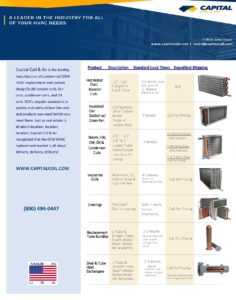
While building numerous types of coils for various customers over the years, we’ve discovered the four main things that you need when replacing HVAC coils. We’ve found that most customers are searching for many of the same things, and also share many of the same priorities. Based on numerous conversations with our customers, we’ve compiled a list of the primary factors that you need to consider when purchasing an HVAC coil.

  • Marketing and advertising experts’ claim that a person needs to see and/or hear something an average of 3-5 times for the brain to really absorb the message. And so, in light of that claim, think DELIVERY, DELIVERY, DELIVERY, and DELIVERY! Every coil job has a degree of urgency to it, which is why the speed of delivery is so significant. Either you are beginning the process of replacing coils for a system that is shut Quick-Shipdown, or you are in the middle of a job and discover that you need coils to be delivered as soon as possible. In either scenario, you need a coil supplier that works on your schedule – not their own, independent timetable. Capital Coil’s Quick Ship Program allows the coils to be built on your timeline, not the manufacturer’s.
  • The coil MUST fit in the space allowed! You can purchase the highest quality coil ever manufactured, and if it does not fit, then you have nothing more than exquisitely manufactured scrap metal. So when measuring a coil, always remember that a little smaller is always better than a little bigger. There are 100 different ways to make a smaller coil work for you. On the flip-side, if a coil is too big, then you have no choice but to start over.
  • Performance matters! As with any purchase, it’s important to have an idea of what you are trying to accomplish. The simple act of duplicating a coil can sometimes work, but more often than not, additional performance information is needed. This is precisely where Capital Coil & Air can help. We’ll work with you to come up with a simulated performance schedule, even if you do not have all of the necessary information. Working in consultation with our clients tends to lead to an outcome that is acceptable to all parties.
  • Lastly and very importantly, there is cost. Everyone has budgetary constraints, and no one wants to break the bank paying for coils. However, buying a coil is often more than simply price alone. Taking into account required delivery times, sizing of the coils for the job, performance, and price, buying a coil can be a balancing act. While price should not be minimized, buying the cheapest coil is seldom the best coil for your job or application. The adage “you get what you pay for” certainly applies when it comes to coils. Capital Coil’s main goal is to help lessen your overall price, without sacrificing performance and quality.
 
 Performance options, size options, and shipment options will help you to spend your money in the most effective way possible. Capital Coil’s job is to give you the options and information that will allow you to make the best decision in your buying process. Your success is our success, so our goal is to have an on-going, consultative relationship that works for both parties. Call us on your next job, we’d love the chance to earn your business.
 

RELATED POSTS

Replacement HVAC Coils: 10 Common Ordering Mistakes

Coil Costs: What will make your HVAC coil more expensive?

Stock Hot Water Coils – Quick Buyers Guide