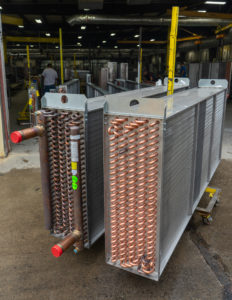
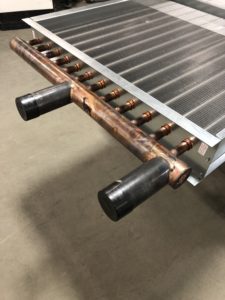
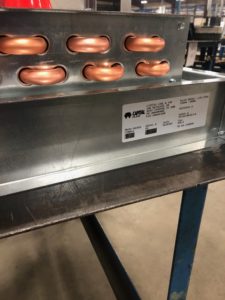
Top 10 Chilled Water Coil Facts

Every Chilled Water Coil selection is about balance. Your coil selection balances the rows/fins versus the cost of the coil pressure drops/performance. Trying to cut corners on your initial selection may save you money upfront, but you will inevitably pay it back down the line through added energy costs. This is a truism for every manufactured coil.

  1. Fins cost less money than rows/tubes. A good cost-cutting tool when selecting a coil is to choose 14 fins/inch. This will turn your (8) row coil into a (6) row coil, which will dramatically lower your costs. If you choose to go this route, one thing to keep in mind is that 14 fins/inch will be semi-inconvenient to any maintenance crew tasked with cleaning the coil. Don’t expect a Christmas card from them that year.
  2. That raises the question of whether or not you can even clean a deep (6) or (8) row coil? In short, you can, but it is not easy. Chilled water coils are especially difficult to clean because they are almost always wet. Due to this fact, they typically attract dirt and additional particles that other coils do not. Generally, when cleaning a coil, most of the dirt get pushed to the middle, and for that reason, 14 fins/inch may not be the best idea after all. Chilled Water Coils
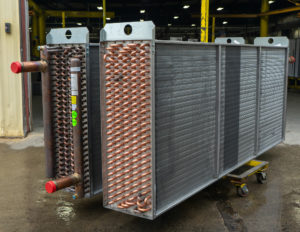
  3. Did you know that fins do approximately 70% of the heat transfer in a chilled water coil, while the tubes are only responsible for the remaining 30%? This is precisely why the fin/tube bond is so important. Without a perfectly crafted fin/tube bond, coils become inefficient very quickly. You pay for that inefficiency through increased energy costs.
  4. How long does a coil last? At what age can I expect my coil to fail? Unfortunately, there is no single answer to either question. Everything is dependent on a combination of maintenance, duty, and numerous other factors. If your initial selection was correctly chosen, and proper maintenance was kept, 15-20 years is a good timeframe.
  5. You may have a situation where your coil is 20 years old, and everything appears to be operating in good condition. There are no leaks and all looks ok. However, over that length of time, what you don’t see is that the fins have thinned and are no longer bonded to the tubes, and the coil is dirty in places that you cannot see. Again, while the coil may look to be running in top form, it’s probably only running at 60% capacity. Most likely, the tubes have also thinned over time, so when the next deep freeze occurs, you can guess the likely outcome.
  6. You really need to replace the coil, but have been told to make do with the current coil? To make up for the lack of efficiency, you might try to “jury-rig” your system. One method is to change the drive on the fans to deliver more CFM. This increases the air pressure drop, which in turn increases motor brake horsepower. Another option to help increase the coil’s efficiency is to lower the temperature of the chilled water from the chiller. We tend to mess with the system and apply temporary Band-Aids, when replacing the coil is the only guaranteed long-term solution.
  7. If you want to spend money wisely on a chilled water coil, simply make the tubes thicker. The tube thickness for a 5/8” tube coil is .020” thick, so increase the tube thickness to .025”. The same applies for a ½” tube coil, with a tube thickness of .016”. Increase it to .020”. By doing this, you get the added bonus of making your return bends thicker, which also helps to extend the life of the coil.
  8. Not quite sure about circuiting on a chilled water coil? You are going to have a hard time making an accurate selection unless you understand how to circuit a coil. Circuiting is really nothing more than selecting the number of tubes that you want to feed, and how many passes the water makes through the coil – depending on your GPM. Circuiting is one of the most important factors in ensuring that your coil is running at peak-performance.
  9. Curious about the balance between cost, size, materials, and maintenance? Every chilled water coil needs to be maintained for its entire life-span. If you’ve made your selection, and something seems off about the coils, chances are mistakes were made during the selection process. Some indicators include the coil being too big for the space allowed, or incurring out of control energy costs. What is the point of saving $500 on a chilled water coil if you have to spend $5,000 in maintenance over its life-span?

As coil replacement experts, we run into this issue every day. Our goal is to work with you to ensure your selections are correct the first time. The person in charge of budgets will be grateful to you over time. Capital Coil & Air welcomes the opportunity to work with you on your next coil project! We want to be your coil replacement specialists.

 RELATED POSTS

Chilled Water Coil Circuiting Made Easy
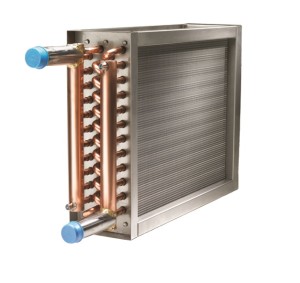
Chilled Water Coils & Moisture Carryover

Top 10 Things You Need to Know About Chilled Water Coils


10 Things To Know About Chilled Water Coils

Chilled Water Coil

1. Hot or chilled water coils are still water coils. There is really no difference between hot water coils and a chilled water coils in construction. Hot water coils are usually 1 or 2 rows and chilled water coils are usually 3 to 12 rows deep.

2. The vast majority of chilled water coils are constructed from either 1/2″ OD tubes or 5/8″ OD tubes. A lot of that depends on the tooling of the original equipment manufacturer and what is more economical. Either size can be used and substituted for each other, which makes replacing your coil that much easier.

3. 1/2″ Tubes are on 1.25″ center to center distance. 5/8″ tubes are on 1.5″ center to center distance. For example, if a chilled water coil has a 30″ fin height, there will be (24) 1/2″ tubes per row or (20) 5/8″ tubes per row. The tube area of the coil is remarkably the same. They are almost interchangeable.

4. The quality of the coil often times is directly tied to the tube thickness. Many installations have water not treated properly or tube velocities that are too high. There are few perfect installations in real life. Increasing the tube wall thickness on a chilled water coil is a great way to ensure longer life.

5. Fins make great filters! Of course, they are not designed to be filters, but it happens. You can make any coil cheaper by making them 14 fins/inch with less rows rather than 8 or 10 fins/inch. Just remember that deep coils are very difficult to clean. Cheap is not the way to go most of the time!

6. Fins are designed for maximum heat transfer. They are much more complicated in design than they appear to be when looking at the chilled water coil. They are rippled on the edge to break up the air. They are corrugated throughout the depth of the fin. The tubes are staggered from row to row and the fin collars are extended. All of this to maximize heat transfer. Unfortunately, the byproduct of this is the fins can end up being great filters. Be careful in the design of any chilled water coil.

7. Fins are aluminum for a reason! They give you great heat transfer at an economical cost. You need a compelling reason to switch to copper fins as copper is very expensive, and you’re likely to double (or maybe triple) the cost of the coil. Coatings are popular for this very reason.

8. Many chilled water coils are built with 304 stainless steel casings. The casings are stronger, they last longer, they are stackable, and it’s fairly inexpensive. After all, what is the point of building the best coil possible and have the casing disintegrate over time around the coil? Sometimes, it’s money well spent!

9. Circuiting the coil is the tricky part of any coil. Circuiting is nothing more than the number of tubes that you want to feed from a header. There are two rules. You must keep the water velocity over 1 foot/second and below 6 feet/second. 3-4 feet/second is optimum. The second is the number of tubes that you feed must divide evenly into the number of tubes in the coil.

10. Replacing  your chilled water coil is easy. Rarely do you have to worry about the performance. When you replace a 20 year old coil, it is dirty and the fin/tube bond is not good. The coil is probably operating at 1/2 of its capacity at best. When you put a new coil on the job, your performance will automatically be terrific. Your main concern is now making the sure the coil physically fits in the space allowed. And always have this in the back of your mind: Smaller is always better than too large. Smaller you can always work with, whereas too large makes for a very ugly and expensive coffee table.

There you have it – everything you need to know about chilled water coils. Interested in learning more, please reach out to Capital Coil & Air! We look forward to the opportunity to be your coil replacement specialists!

RELATED POSTS

DX & Chilled Water Cabinet Coils

Coils and Counter-flow: 5 Common Questions

Top 5 Reasons HVAC Coils Prematurely Fail


OEM Replacement Coils: Repair or Replace

When considering OEM replacement coils, there are multiple reasons why coils can fail prematurely. Sometimes, OEM Coils simply freeze and can never be repaired. Other times, the coil was selected incorrectly, which in turn, made the coil significantly underperform. Many times, there is substantial corrosion or something else in the system that causes the coil to fail. However, most coils, when selected correctly, and in systems that are properly maintained, can last anywhere from 10-30 years!  10-30 years is also a pretty wide range, and there are many variables in how long you can expect a coil to perform. Factors, such as ongoing maintenance, air quality, and water/steam quality all have an effect on a coil’s lifespan.

OEM Replacement Coils

Reasons Why Coils Fail Of Old Age

  • While the coil’s tubes are considered the primary surface, 70% of all coil performance is performed by the finned area on a coil, which is known as the secondary surface. The fin/tube bond is easily the most important manufacturing feature in any coil. Without the bond between the tubes and fins, the coil could never properly function. Like all things however, over time the fin/tube bond becomes less efficient with constant expansion and contraction. While the construction of the coil, as well as the fin collars, does not allow the fins on the coil to move, that fin/tube bond naturally weakens a coil’s life over time after installation. Because of this, it is not a stretch to say that a coil is easily 30% less efficient after (20) years.
  • Cleaning coils often pushes dirt to the center of the coil, and this occurs even more so on wet cooling coils. Just remember that coils can become great air filters if not properly maintained. The BTU output of any coil is in direct proportion to the amount of air going through the coil. If you decrease the CFM by 20%, you are also decrease the BTU’s by 20%!
  • Cleaning agents often corrode aluminum fins. Since every square inch of fin surface matters in performance, corrosion of the fin surface is always detrimental to the coil’s performance.
  • Many times, there are coil leaks simply because of old age. No coils are immune to erosion. You might find the brazing in the tubes, as well as the brazing in the header/tube connections failing over time. Steam can be both erosive and corrosive under higher pressures. Water travels through the coil at 2 – 5 ft/second, so erosion is an enormous part of coil failure, regardless of how well-maintained. Erosion is always there, whether you realize it or not.
  • Water/steam treatment and the corrosive effects of bad steam/water can all be causes of coil failure…which then necessitates the need for a reliable manufacturer for OEM replacement coils.

So What Is The Solution?

Some coils can last 5 years, and some coils can last 30 years. As you have read, there are numerous factors that contribute to a coil’s life. In the end, there will most likely have been multiple attempts to repair that coil to make it last as long as possible. The depressing news is that most of these “Band-Aid” attempts do not work well. The most likely outcome is that you are buying a new coil anyway, so why waste the time and money on a temporary solution?

Coil failure is a “pressure event”, which is a fancy way of saying that a coil is leaking. We’ve listed some of the most common repair methods that you are likely to come across:

  • Drop leaking tubes from the circuit: Keep in mind however that every dropped tube reduces the coil’s performance by triple the surface area of the tube that is dropped. Again, while ok in the short-term, this is simply another “Band-Aid” fix. Over time, your energy costs will rise exponentially, and you will probably end up buying a new coil anyway.
  • Braze over the existing braze: As mentioned above, erosion has caused the original braze to fail, so all that you are really doing is pushing the pressure to another braze, which will then begin to fail as well.
  • High Pressure Cleaning: This method bends the fins, further restricts the airflow, and pushes dirt more to the center of the coil, which can never be adequately cleaned.

The real reason why coils need to be replaced rather than repaired is due to energy costs. If your coil is not operating near desired levels, you’ll need to increase the energy to make it work at its peak performance. Energy increases might be slight at first, but they are guaranteed to continue to rise over time. For example:

  • Somebody adjusts the fan drive for higher speeds, higher CFM’s and higher BTU’s.
  • Someone adjusts the boiler; the water and steam temperatures are higher.
  • Someone adjusts the chiller (1) degree higher for colder water to the chilled water coil.

Whichever method is used, performance begins to suffer and adjustments to the system occur. These adjustments cost energy efficiency and ultimately, money!

If you have ever experienced repairing a coil, then you know it is labor intensive and typically will not work as a permanent solution. With very few exceptions, repairs should be seen as nothing more than temporary until you’re able to replace that coil!

Capital Coil & Air has seen every “repair” method used, as well its inevitable outcome, so instead of putting yourself through that, call Capital Coil and allow us to be your coil replacement experts.

RELATED POSTS

Is Your Quick-ship Shut Down When Needed Most??

Four Things That You Need When Buying Replacement Coils

Replacement HVAC Coils: 10 Common Ordering Mistakes

Top 5 Reasons HVAC Coils Prematurely Fail


Cooling Coils & Moisture Carryover

Moisture carryover is present on cooling coils where dehumidification happens.  Many people do not think it’s a problem…until you have moisture running down ductwork or spewing all over the inside of an air handler. If you’ve ever experienced that then you probably know all of these rules regarding moisture carryover.

  • Entering air temperatures of 80/67 of return air in the Northeast carry far less moisture than an outside 95/78 entering air temperature in Florida. Outside air always has more moisture. Cooling Coils

    -Your location plays a part as well. The drain pans will absolutely have be sized differently. Florida’s will be much larger in size.

  • Fin design is irrelevant when it comes to moisture carryover. Whether you have copper corrugated fins, or aluminum flat fins, plate fins or even the old fashioned spiral fins, none of it has any effect on moisture carryover.
  • Lastly, be careful when installing a new chilled water or DX (Evaporator) Coils in a system. Many end users like to increase the airflow on older coils because those old coils can act like filters, the fins are covered in dirt/dust and you’re not getting the same airflow through the coil. This dirt on the coil also semi-prevents moisture carryover. When that brand new chilled water coil is installed, the airflow might be higher than that of 550 ft/minute, which of course will cause moisture carryover problems. 

Please give us a call with any questions about your coil, your system or its design. Capital Coil is here to help you avoid situations like the one described in this post, and we would love for the chance to work with you!


RELATED POSTS

10 Things You Need to Know About Chilled Water Coils

Top 10 Chilled Water Coil Facts

Chilled Water Coil Circuiting Made Easy
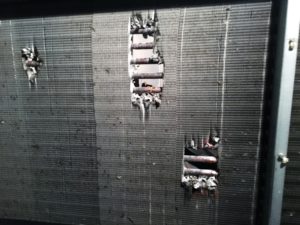

Case Study: We Need These Coils on a (5) Day Quick-ship

In late June, Capital Coil received a call from a Trane office in Ohio regarding quick-ship availability. One of Trane’s top customers had an urgent need for (12) large chilled water coils with stainless steel casing. The problem/hurdle that they were encountering was that they needed all (12) coils to be built and ship out of the factory in (5) business days. Completion of the whole project was 100% contingent on them receiving the coils in their specified time-frame. An additional complication was the fact that July 4th was the following week, and they needed to have the coils ship prior to the holiday.

Trane shopped the project around to different manufacturers, but not one could guarantee to ship in (5) days. Some manufacturers waffled and claimed that they could have them built in (6) or (7) days, but not one could guarantee to ship in (5) days. A sales rep in that same Trane office, who had worked with Capital Coil previously, suggested that his co-worker reach out to us to see what we could do. After speaking with Trane’s project manager, we immediately contacted our head of production to make sure that we had the capacity to complete all (12) coils in the required (5) days. She assured us that we had the materials and manpower on-hand to get them all built and ship on time. We agreed to accept the project and began work on the coils immediately.

Due to the size of the project, as well as it’s time-sensitivity, we had multiple calls daily with our factory to ensure that everything was proceeding on schedule. We then gave Trane daily status updates, so they were constantly informed of everything from the brazing of the coils to entering the final testing phase. Chilled Water Coil

As promised, all (12) coils were built correctly and shipped out in the required (5) days. Our logistics team was then in constant communication with the freight company to make sure that the delivery was on schedule. And just like during the production phase, we passed daily tracking updates along to Trane, so they knew where their coils were at all times and when they could expect delivery. All (12) chilled water coils arrived on July 3rd with zero freight damage, and the project was completed on time!

A company as large and influential as Trane can have their coils built by anyone, but Capital Coil was the only manufacturer that could guarantee to have their coils built and shipped by a required date. Additionally, in working so closely with Trane throughout the whole process, they were kept up-to-date in real time from the start of production to final delivery.

Capital Coil offers a level of service that you won’t get with other manufacturers. When we guarantee to ship by a certain date, we stand by that guarantee, or you do not pay!


Trane’s project manager’s comments to Capital Coil upon completion/delivery:

“This will help us get a jump on this project prior to the big event taking place next week! 

I will make sure to share your information with others across our great lakes region about our experience with your company, so that they know we have THIS option to go to for our coil needs. THANK YOU ALL!!”


5 Work Day Quick-Ships on HVAC Coils – Why Capital Coil does it right

Day 1 – 38% of all orders sent to Capital Coil are on some kind of quick-ship, whether it be on a (5 day, 10 day, or 15 day). We enter the order immediately so that all departments in the plant have the project in their systems and are ready to move on it right away. The coil isQuick-Ships engineered, routing sheets are sent to the shop floor, and everybody now knows what needs to be built. 

Day 2 – Sheet metal casings are cut and sized, headers and connections are fabricated, while tube sheets are fabricated.

Day 3 – All tubing and fins are cut, stamped and assembly begins. You can see what the coil will look like upon final assembly at this point. Coils can be seen sitting on assembly tables.

Day 4 – Tubes are then expanded into the fins, and keep in mind that this is not a short process. Headers are then brazed to the tubes, and if there are return bends, they are connected. The coil is completely assembled and moved to the testing tank. The coil is tested under water for 20 minutes at 550 PSI. About 3% of coils have small leaks someplace in the brazing and are sent back to braze again.

Day 5 – The coil is crated and sent to shipping for routing to the customer. Then most importantly, your coil will be shipping in the guaranteed (5) days.

As you can see by this description, with quick-ships, there is not a lot of room for error in the timing and shipping with OEM HVAC replacement coils. We’ve been doing this for a while now, and we’ve had an approximately (97%) success rate fulfilling all quick-ship requests. We offer quick shipments 365 days per year, with both (10) day shipments & (15) day shipments also available for lower premiums.

diagram 

RELATED POSTS

Are Your Quick-Ships Shut Down When Needed Most???

How to make your HVAC OEM Replacement Coil Buying Process Easier??

OEM Replacement Coils: Repair or Replace???


Why Are Fin Designs On HVAC Replacement Coils Important?

Replacement HVAC Coils

At first glance, fin designs on HVAC replacement coils seem about as exciting as watching grass grow. “Why would I ever care about fin designs on any coil” was probably your initial response to our question. Nevertheless, we would not dedicate a newsletter to this subject if fins were not important.

One of the primary reasons fins are so important is that you want to keep your coil as clean and maintained as possible. In order to properly maintain your coil, you need to have an understanding as to how HVAC replacement coils are constructed. While fins do not look like much, they are MUCH more complicated than what you can observe at the entering or leaving airside of the coil.

To begin, fins are responsible for a surprising 65% – 70% of the heat transfer on any coil, while tubes are responsible for the remaining 30% – 35%. Additionally, in order for your coil to work at optimum performance, you need to have a terrific fin/tube bond, (which we will discuss below).

  1. Fins are known as secondary surface, while tubes are referred to as primary surface. While this may seem counter-intuitive, the secondary surface is responsible for twice the amount of heat transfer as the primary surface.
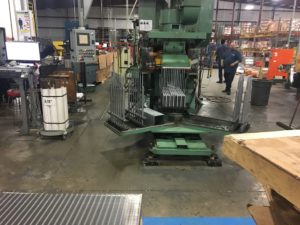
  2. There are special dies (see picture) that stamp out aluminum or copper fins with the correct thickness, height, and depth to make the coil the correct size. For example, a coil might be 36” (height) x 96” (length) x (8) rows deep x 8 fins/inch.
    1. Fin Height: 36”
    2. Fin Depth: 12”, (8) rows deep
    3. # of fins in the coil: 768 (8 fins x 96”)
  3. Each fin has 192 holes stamped in the fin for 5/8” OD tubes (8 Rows x 24 Tubes), and each fin is identical.
  4. Each hole has extruded metal, which is more commonly referred to as the fin collar. The collars are sized to self-space the fins and allow for later expansion of the tube into the fin collar. This practice is also known as “bonding” and is essential to having your coil run efficiently/correctly.
  5. Each fin is rippled at the entering and leaving edge of the fin to help create air turbulence.
  6. Each fin is corrugated in the direction of airflow to allow for greater air turbulence. This is important to remember because turbulence creates heat transfer.

So again, what is the point of understanding the importance of fins in HVAC coils? While coils can be built with flat fins for various reasons, the vast majority of coils are built with enhanced fins. Enhanced fins help to ensure that the airflow is not running straight through the coil.

Regardless of fin type, keep in mind that HVAC coils can and will act as great “filters”. The tubes are staggered and not in-line; while the fins are designed to help break up the airflow and not facilitate an easy, straight-through air path. Dirt and/or other particles in the air get caught easily, which again, is why coils can act as great filters. Additionally, coils with more rows will usually get dirtier than coils with less rows. Lastly, chilled water or DX coils are typically wet coils, which results in them catching virtually everything in the air.

The amount of BTU’s through any coil is in direct proportion to the amount of air through the coil. For example, if you are only getting 90% of the design air through the coil, then you are only getting 90% of the BTU’s.

Coils require good filtration and periodic maintenance. If not done correctly, you’ll pay the price of higher energy costs on an inefficient coil.

By now, you have hopefully come to the realization that HVAC coils are much more complicated than they appear, and that fins are an integral part of the coil as a whole. Again, while admittedly not the most exciting topic, understanding the role and importance of fins in HVAC coils cannot be overstated. Capital Coil & Air is here to help you with any and all coil selections, and we look forward to working with you on your next project.

RELATED POSTS

Repair or Replacement Coils?

Top 5 Reasons HVAC Coils Prematurely Fail

Are You Asking Your Coil Supplier These Questions?


Syracuse University Athletic Dome Renovation

Capital Coil & Air prides itself on its ability handle all jobs – large or small! We quote anywhere from 25-50 projects/day, and there is typically a very diverse mixture of equipment and overall size & scope of projects that need to be engineered and quoted. The majority of our business comes from repeat customers because they know that we treat every job and request with the same importance – regardless of size. Today’s newsletter highlights one of our largest jobs to date to illustrate the fact that Capital Coil has the ability handle any job…no matter the size and scope.

Capital Coil has long understood that your businesses and customers depend on fast responses, fast engineering, fast shipping, and top-quality products. Again, whether it’s (2) small hot water duct-coils that you need overnighted, or banks of chilled water coils, Capital Coil wants you as our customer to be satisfied that you got a “fair-deal” with us on each and every job.

The Syracuse University Dome (SU Dome), in Syracuse, NY underwent an extensive renovation at a cost of $205 million. The old roof was air-inflated/supported and was replaced with an updated design-frame roof. As part of the total renovation, the building also changed out it bathrooms, Wi-Fi, LED lighting, and entire HVAC system. As part of the renovation, Capital Coil was asked to build (64) chilled water coils as a part of the air conditioning renovation project.Capital Coil

Modular Comfort Systems, located in Syracuse, contacted Capital Coil & Air during the planning and budgeting phase of this project. Modular Comfort Systems is a large and highly respected HVAC Representative in central New York State. After purchasing coils from CCA, they re-sold those same coils, as well as other HVAC equipment to the also very highly respected Burns Bros. Mechanical Contractors – also located in Syracuse. Burns Brothers has been working in HVAC, plumbing and process piping for more than 100 years. Both of these companies are the types of companies that Syracuse University would entrust with such an important and high-profile job.

Capital Coil built (64) free-standing chilled water coils in sizes ranging from (33” x 93”) – (33” x 118”). All (64) coils are (8) rows with 304 stainless steel casing, increased tube wall thickness of .035”, with connections built and oriented at 90 degrees to facilitate ease of piping. The coils have all been highly engineered and are exactly correct for this application/project. Each coil weighs over 1,000 lbs, so Capital Coil split up the total order into (2) separate shipments, two weeks apart, in order to help the contractor receive the delivery.

The point of this case-study is to show how proud Capital Coil & Air is to have been tasked with building coils for such a high-profile project. Capital Coil is also proud to have worked with professional organizations like Modular Comfort Systems and Burns Brothers Mechanical. But regardless of the size of the project, you’ll receive the same attention and support as anyone else who reaches out for our assistance. Please contact us as we look forward to working with you on your next project!!

RELATED POSTS

Boca Raton Hospital Covid-19 Care Condenser Coils

10 Things To Know About Chilled Water Coils

Guidelines For Air Velocities

Coils and Counter-flow: 5 Common Questions


Are Your Quick-Ships Shut Down When Needed Most???

Why are quick-ships so important??

Christmas season is in full-swing, and your current coil supplier has suspended all Quick-Ships with little to zero notice to its customers. Does that sound familiar these days? Additionally, the clock is ticking to complete those projects that need to be done by the end of the year. In this industry, this scenario is when “Quick-Ship” availability is an absolute must. Right now, the vast majority of coil manufacturers are scrambling to complete standard orders on regular lead-times, and if by dumb-luck they are able to temporarily offer any type of expedited build, the added premiums are so astronomical that very few customers can afford to use those options.

If you need a new coil, your first inclination will probably be to call the OEM. But more times than not, they are not flexible or nimble enough to handle your emergency within an acceptable time-frame. Quick-ships are generally based on emergency conditions, and that is precisely the worst time to discover that your regular supplier has suspended Quick-Ships.

So why do so many manufacturers seem to get so overwhelmed at various point every year? In short, many manufacturers take on a glut of OEM business, or other large projects with small profit margins. In many cases they do this simply to keep the factory running during the slower periods of the year. This has the effect of delaying standard lead times, and in many cases, cancelling Quick-Ships altogether. It is very hard to do business with companies that make themselves unavailable when you need them the most.

Capital Coil’s primary duty as the leading OEM replacement coil manufacturer is to fill in those gaps and work with you to help alleviate any emergencies. Whether you need a coil in (3) weeks, or (5) days, Capital Coil has got you covered.

Capital Coil does not try to be all things to all customers, and we’re most comfortable “staying in our lane”. Our #1 goal is to ensure that we have multiple quick-ship options open all year around…even if that means turning away an order to ensure sure that our Quick-Ships are ALWAYS available!!  Quick-ships

Because Quick-Ships make up such a substantial portion of our overall business, Capital Coil has hit 99.9% of our quick-ship requests over the last (2) years. An unfortunate forklift mistake makes up the other .1%. Throughout the first 6 months of 2022, approximately 80% of all orders were/are quick-ships, and they have either all been completed on time, or are 100% on schedule.

An RFQ that sits on a desk unanswered is useless to everyone involved. If you need a quote, you’ll have your price and any required submittals that same day. It really is that simple and easy! Working with Capital Coil will remove many, if not all of the annoying and unannounced shut-downs that come with other manufacturers, so please let us help you when you need it the most!


RELATED POSTS

Uncertain About Recent Changes In The HVAC Industry?

Repair or Replace Your HVAC Coils?

10 Things You Need to Know to Buy Replacement Coils Effectively


How Did The HVAC Commercial Coil Replacement Market Originate???

How in the world did the commercial coil replacement market start? This specific newsletter is more of a story than anything technical that we have covered in most of our previous emails or blogs. Rather, this is the story of how one manufacturer’s representative, Robert Jacobs, almost by accident, stumbled upon the concept of the coil replacement market back at a time when the only way one could get a replacement coil was to go through the original equipment manufacturer – (OEM). In full disclosure, Bob Jacobs is the VP of Business Development with Capital Coil & Air.

Way back in the day – (1970’s) – HVAC coils were not stand-alone pieces of equipment as they are considered by some now. Coils were nothing more than a single part in an Air Handling Unit (AHU) or a bank of coils. Like a bearing, a drive, or fan wheel, coils were simply part #’s that one needed to reference with the OEM in order to get a replacement built. This situation was a very good deal for the OEM’s because much like car parts, they could charge upwards of 3x’s the original cost of the coil or “part”. And, it was built according to their schedule/timeline, not yours’.

In the 1970’s, Bob Jacobs was a manufacturer’s rep in the Philadelphia-area, and his main line of equipment was Bohn Aluminum & Brass. Bohn was a division of Gulf & Western and competed against many of the top manufacturers, such as Trane & Carrier. For comparison-sake, Bohn was very similar to what Dunham-Bush is today.Commercial Coil Replacement

During this period, Bob Jacobs was asked by numerous local contractors to replace old and/or broken coils. Due to the lack of a quality alternative, he initially used Bohn for coil replacement projects, but replacing coils was not exactly Bohn’s “sweet spot”. It should be mentioned that during this period, replacement coils were not really on any manufacturer’s radar as a separate product – hence the point of this story. Regardless of the OEM, standard lead-times were upwards of (12) – (14) weeks, and those “replacement parts” were very expensive. It was during this period that he realized that there was serious potential for some kind of HVAC coil replacement market. To test this theory, he initially spent $75.00 on an ad deep within the classified section of “Air Conditioning & Refrigeration News”. It was the old type where one had to “circle the bingo card” to request additional information, and this single ad received over 525 inquiries from across the country!! This eye-opening initial response to his idea made him realize that he had come across something good, but now the challenge was how to satisfy this new market. Bob Jacobs initially contacted Bohn to see if there was any interest in building replacement coils, as well as marketing the idea across the United States. Bohn essentially laughed at the idea and countered that he’d be violating his sales rep agreement by going into the territories of other reps. This was very flawed reasoning as none of the other reps were engineering or selling replacement coils in the first place! Within a week, he had canceled his agreement with Bohn and was looking for alternative vendors. He also decided to run a second ad that received another 450 inquiries; furthering his idea of the need for a coil replacement market.

The next step was to reach out to Singer Coils (yes, like the sewing machine), who was located in North Carolina. Because they had built coils for other manufacturers, he pitched his idea to them along with the request that they build his special or “custom” coils. While initially skeptical of the concept, the doubters were proved wrong as his firm gave Singer over $3,500,000 in business in that first year alone. Admittedly, that $ amount in the first year in a brand new market is impressive whether it’s 1971 or 2021!!

One must also remember that these were the days before fax machines and most certainly before email and the internet. Quote requests for coils were received via USPS and were hand-drawn sketches written on things, such as legal pads, envelopes and pretty much every way imaginable compared with today. Because everything was starting from scratch at this time, there were no coil model libraries or other materials to cross-reference, so going through a random building trying to locate the correct coil to replace could be torturous. However, over the next 6-8 years, his business grew quite rapidly, and he was able to collect and build a substantial reference library of coil drawings and other relevant information. The experiences of the prior 8 years, coupled with his firm’s knowledge of commercial coils, eventually allowed his company to begin building their own replacement coils for the 1st time, rather than relying on a 3rd party manufacturer.

Bob Jacobs’ original coil replacement company developed relationships with literally thousands of customers and laid out the initial blueprint for success in the coil replacement business. Due to that success, you now have approximately (10) alternatives that have attempted to copy his model as it’s become obvious that this is a lucrative market. Even OEM’s have recognized that they need to have a piece of the replacement market. But an important point to remember is that just because a company says or even advertises that they are in the coil replacement business does not mean that they are any good or even fully understand how the replacement market operates. For example, most coil manufacturers today are still more interested in the production of larger quantities, so replacement coils are “special” to them. In other words, sometimes these manufacturers want to be in the coil replacement business, and other times, without telling you, they do not. And not knowing where a company’s focus or priorities lie makes it extremely difficult to work with them under emergency conditions.

Bob Jacobs was there at the beginning and is still quite active within Capital Coil. Having daily access to a resource that literally invented the coil replacement market is what separates Capital Coil from all other competitors. Capital Coil will continue to be your coil replacement experts, and we greatly look forward to the chance to work with you on future projects.

RELATED POSTS

How to make your HVAC OEM Replacement Coil Buying Process Easier??

How to Identify Different Types of Coil Manufacturers

Does Your HVAC Coil Selection Program Leave You With More Questions Than Answers?