Tips on Hand Designation & “Counter-flow”

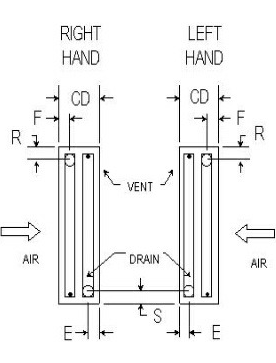
Are your chilled water coils right hand or left hand?  Are you looking into the face of the coil with the air hitting you in the back of the head?  What exactly is counter-flow and why is it important?  Are you completely confused by why right hand vs. left hand even exists?  Most manufacturers probably do not know or understand the technical reasons themselves.

First, let’s figure out what coils even need a hand determination.  Chilled Water Coils, Direct Expansion (Evaporator) Coils, and Condenser Coils are the only coils that need this figured on almost every job.  Hot Water Coils, Booster Coils, and Steam Coils rarely need this determination!  The reason for this is when the coils are only 1 or 2 rows deep, they can be flipped over.  When a chilled water coil is 3+ rows deep, hand determination is much more important because it needs to be counter-flow.  With most suppliers determining hand designation with the air hitting you in the back of the head….do you want the connections on the right or left?
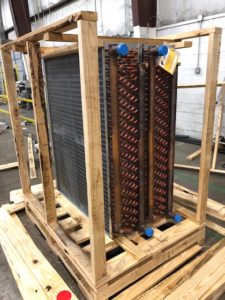
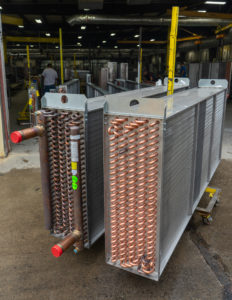
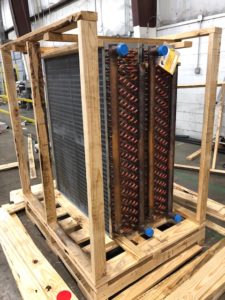
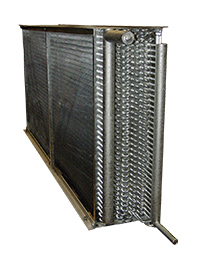
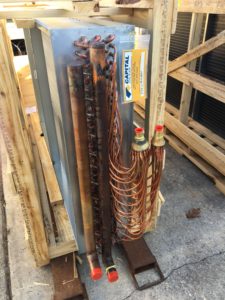
Chilled Water CoilsYou’ve probably heard the term “counter-flow” countless times, but here’s the simplest explanation.  For peak performance, you want the air and the fluid traveling in opposite directions through the coil.  Is it the end of the world if your coils are not counter-flow?  The short answer is no, but you will lose approximately 5% of the output.  So if your coils are piped incorrectly, don’t expect to get the full performance, but they will still be more effective than whatever you’re replacing.  Steam and hot water coils are 1 or 2 rows deep, so again, counter-flow is pretty much irrelevant.  However, it can make a difference with any chilled water or direct expansion coils (3-12) rows deep.

We also get asked many times “what is the proper way to pipe coils?”  Put simply, steam coils should always be fed on the highest connection and the return on the lowest connection.  Water coils should always be fed on the lowest connection and returned on the top connection to ensure that all of the tubes are are fed the same volume of fluid. 

Hand designation and counter-flow are two pretty simple concepts when they are properly explained.  When dealing with a HVAC coil manufacturer, partner up with one who will walk you through the engineering and explain it along the way.  Capital Coil & Air has well over a decade of experience in handling pretty much any scenario that you may come across, so we want to be your coil resource for any and all projects. Please give us a try on your next job!

RELATED POSTS

Why are HVAC Coils Copper Tube and Aluminum Fin?

Did You Know? Facts about Commercial HVAC Coils

You should never have to worry about performance on replacement coils…Well, almost never!


Coils and Counter-flow: 5 Common Questions

1)  Coils and counter-flow?

The first thing to remember about coils and counter-flow is that chilled water coils are always built to be piped in counter-flow. This means that the air flows in the opposite direction as the water. For example, with counter-flow, the air flows through rows 1-8, while the water runs through rows 8-1. Water always travels through the coil in the opposite direction of the air; hence the term “counter-flow.”  Direct Expansion Coils (Evaporator Coils) are also piped in the same manner.

With that said, what happens when you do not pipe cooling coils counter-flow? Almost all coil selection programs you will see or use will be based on counter-flow conditions. If you opt to not counter-flow a chilled water coil, you’ll have to reduce the coil’s overall performance by a certain percentage. That percentage reduction varies based on each coil’s unique dimensions, but a reliable estimate is a loss of 8-12%. Simply piping the coils in the correct manner from the beginning would seem to be the easiest and most cost-effective solution.

2)  Why do you feed from the bottom of the coil?

DX Coils

You always want to feed a water coil from the bottom connection so that the header fills from the bottom on up and feeds every tube connection evenly. All tubes must be fed evenly with the same amount of water. If you try to feed the header from the top, you greatly increase the risk of “short circuiting” the coil and having a higher water flow through the top tubes in the coil.

3)  What is a Water Hammer in a Steam Coil?

On a long Steam Coil, you will be hard pressed to get the steam through the length of the coil. Slowly but surely, that steam converts into condensate, which is pretty much the worst thing that can happen to any system. If not evacuated, the condensate just lays in the coil when the system is shut off. This problem comes into play when the steam is turned back on and meets the condensate laying inside the coil. In addition to the noise, the steam and condensate cause huge amounts of additional stress on the coil’s joints. As a result, over time, your coil will inevitably fail.

4)  What else happens if you do not evacuate condensate?

When you cannot or do not evacuate the condensate on long steam coils, the condensate ends up blocking the steam. A steam coil should never feel cool to the touch, but when condensate blocks steam, one part of the coil will be warm while the other will be cool. Again, that should not happen. Steam coils are interesting in that they are more dependent upon the system and installation than any other type of coil. A steam coil must be pitched to the return end of the coil. Obviously, steam is not water. Traps, vacuum breakers and other steam accessories must be installed and located properly for the system to function.

5)  Is it necessary to pipe steam and/or hot water coils in counter-flow?

Simply put – no! Circuiting a coil is only necessary to ensure the connections are on the side of the coil that you want. The rows and tubes in the coil dictate how and where you feed, but the steam supply always needs to be the high connection. This method ensures that the leaving condensate is on the bottom of the coil and below the lowest tube within the coil. Whatever else you do, know that the condensate must leave the coil!

If you have any questions or need assistance with ordering and/or installation, please contact a sales engineer at Capital Coil & Air. We will walk with you step-by-step through your entire project should you require any assistance. CALL OR E-MAIL US!  We look forward to the opportunity to work with you on your future projects.


RELATED POSTS

Tips on Hand Designation & Counter-flow

Chilled Water Coils & Moisture Carryover

Chilled Water Coil Circuiting Made Easy


Case Study: We Need These Coils on a (5) Day Quick-ship

In late June, Capital Coil received a call from a Trane office in Ohio regarding quick-ship availability. One of Trane’s top customers had an urgent need for (12) large chilled water coils with stainless steel casing. The problem/hurdle that they were encountering was that they needed all (12) coils to be built and ship out of the factory in (5) business days. Completion of the whole project was 100% contingent on them receiving the coils in their specified time-frame. An additional complication was the fact that July 4th was the following week, and they needed to have the coils ship prior to the holiday.

Trane shopped the project around to different manufacturers, but not one could guarantee to ship in (5) days. Some manufacturers waffled and claimed that they could have them built in (6) or (7) days, but not one could guarantee to ship in (5) days. A sales rep in that same Trane office, who had worked with Capital Coil previously, suggested that his co-worker reach out to us to see what we could do. After speaking with Trane’s project manager, we immediately contacted our head of production to make sure that we had the capacity to complete all (12) coils in the required (5) days. She assured us that we had the materials and manpower on-hand to get them all built and ship on time. We agreed to accept the project and began work on the coils immediately.

Due to the size of the project, as well as it’s time-sensitivity, we had multiple calls daily with our factory to ensure that everything was proceeding on schedule. We then gave Trane daily status updates, so they were constantly informed of everything from the brazing of the coils to entering the final testing phase. Chilled Water Coil

As promised, all (12) coils were built correctly and shipped out in the required (5) days. Our logistics team was then in constant communication with the freight company to make sure that the delivery was on schedule. And just like during the production phase, we passed daily tracking updates along to Trane, so they knew where their coils were at all times and when they could expect delivery. All (12) chilled water coils arrived on July 3rd with zero freight damage, and the project was completed on time!

A company as large and influential as Trane can have their coils built by anyone, but Capital Coil was the only manufacturer that could guarantee to have their coils built and shipped by a required date. Additionally, in working so closely with Trane throughout the whole process, they were kept up-to-date in real time from the start of production to final delivery.

Capital Coil offers a level of service that you won’t get with other manufacturers. When we guarantee to ship by a certain date, we stand by that guarantee, or you do not pay!


Trane’s project manager’s comments to Capital Coil upon completion/delivery:

“This will help us get a jump on this project prior to the big event taking place next week! 

I will make sure to share your information with others across our great lakes region about our experience with your company, so that they know we have THIS option to go to for our coil needs. THANK YOU ALL!!”


5 Work Day Quick-Ships on HVAC Coils – Why Capital Coil does it right

Day 1 – 38% of all orders sent to Capital Coil are on some kind of quick-ship, whether it be on a (5 day, 10 day, or 15 day). We enter the order immediately so that all departments in the plant have the project in their systems and are ready to move on it right away. The coil isQuick-Ships engineered, routing sheets are sent to the shop floor, and everybody now knows what needs to be built. 

Day 2 – Sheet metal casings are cut and sized, headers and connections are fabricated, while tube sheets are fabricated.

Day 3 – All tubing and fins are cut, stamped and assembly begins. You can see what the coil will look like upon final assembly at this point. Coils can be seen sitting on assembly tables.

Day 4 – Tubes are then expanded into the fins, and keep in mind that this is not a short process. Headers are then brazed to the tubes, and if there are return bends, they are connected. The coil is completely assembled and moved to the testing tank. The coil is tested under water for 20 minutes at 550 PSI. About 3% of coils have small leaks someplace in the brazing and are sent back to braze again.

Day 5 – The coil is crated and sent to shipping for routing to the customer. Then most importantly, your coil will be shipping in the guaranteed (5) days.

As you can see by this description, with quick-ships, there is not a lot of room for error in the timing and shipping with OEM HVAC replacement coils. We’ve been doing this for a while now, and we’ve had an approximately (97%) success rate fulfilling all quick-ship requests. We offer quick shipments 365 days per year, with both (10) day shipments & (15) day shipments also available for lower premiums.

diagram 

RELATED POSTS

Are Your Quick-Ships Shut Down When Needed Most???

How to make your HVAC OEM Replacement Coil Buying Process Easier??

OEM Replacement Coils: Repair or Replace???


Syracuse University Athletic Dome Renovation

Capital Coil & Air prides itself on its ability handle all jobs – large or small! We quote anywhere from 25-50 projects/day, and there is typically a very diverse mixture of equipment and overall size & scope of projects that need to be engineered and quoted. The majority of our business comes from repeat customers because they know that we treat every job and request with the same importance – regardless of size. Today’s newsletter highlights one of our largest jobs to date to illustrate the fact that Capital Coil has the ability handle any job…no matter the size and scope.

Capital Coil has long understood that your businesses and customers depend on fast responses, fast engineering, fast shipping, and top-quality products. Again, whether it’s (2) small hot water duct-coils that you need overnighted, or banks of chilled water coils, Capital Coil wants you as our customer to be satisfied that you got a “fair-deal” with us on each and every job.

The Syracuse University Dome (SU Dome), in Syracuse, NY underwent an extensive renovation at a cost of $205 million. The old roof was air-inflated/supported and was replaced with an updated design-frame roof. As part of the total renovation, the building also changed out it bathrooms, Wi-Fi, LED lighting, and entire HVAC system. As part of the renovation, Capital Coil was asked to build (64) chilled water coils as a part of the air conditioning renovation project.Capital Coil

Modular Comfort Systems, located in Syracuse, contacted Capital Coil & Air during the planning and budgeting phase of this project. Modular Comfort Systems is a large and highly respected HVAC Representative in central New York State. After purchasing coils from CCA, they re-sold those same coils, as well as other HVAC equipment to the also very highly respected Burns Bros. Mechanical Contractors – also located in Syracuse. Burns Brothers has been working in HVAC, plumbing and process piping for more than 100 years. Both of these companies are the types of companies that Syracuse University would entrust with such an important and high-profile job.

Capital Coil built (64) free-standing chilled water coils in sizes ranging from (33” x 93”) – (33” x 118”). All (64) coils are (8) rows with 304 stainless steel casing, increased tube wall thickness of .035”, with connections built and oriented at 90 degrees to facilitate ease of piping. The coils have all been highly engineered and are exactly correct for this application/project. Each coil weighs over 1,000 lbs, so Capital Coil split up the total order into (2) separate shipments, two weeks apart, in order to help the contractor receive the delivery.

The point of this case-study is to show how proud Capital Coil & Air is to have been tasked with building coils for such a high-profile project. Capital Coil is also proud to have worked with professional organizations like Modular Comfort Systems and Burns Brothers Mechanical. But regardless of the size of the project, you’ll receive the same attention and support as anyone else who reaches out for our assistance. Please contact us as we look forward to working with you on your next project!!

RELATED POSTS

Boca Raton Hospital Covid-19 Care Condenser Coils

10 Things To Know About Chilled Water Coils

Guidelines For Air Velocities

Coils and Counter-flow: 5 Common Questions


Fan/Coil Units Without the Mysteries

Lots of companies in the HVAC business attempt to keep their products as complicated as possible in order to lend a certain “mystery” to the industry, which has never made sense to us at Capital Coil. We have all been in this information age for quite some time with more information/data available to more people than ever before. We feel that by removing some of the “secrecies” surrounding fan/coil units, our customers will be able to better understand the products as we do.

Most of our potential customers know Capital Coil strictly for our HVAC coils, which makes sense because the word “coil” is in our company’s name. But some people may not be aware that we do in fact offer multiple fan/coil models with various quick-ship options, or that fan/coils comprise a significant portion of Capital Coil’s overall business.

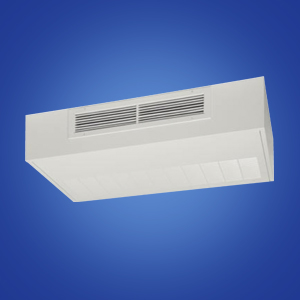
With that said – what are fan/coil units (FCU’s) exactly?fan/coil units

  • Fan/coils are easy to understand when you remove a lot of the complex terminology. Our definition of a FCU unit is one that is direct drive and not belt driven…easy enough to understand, right? There is a fan, a coil, and sometimes a filter. Capital Coil offers numerous model types, but the only thing that really differentiates the various models from each other is the casing on the outside of the unit. And the casing is typically based on how and where you want to install the unit.
  • The fan is directly mounted on the motor, and the maximum CFM that can be used in these units is typically 1,200 FT/min. However, Capital Coil does offer some units that can have a CFM as high as 3,000 FT/min, or (7.5) tons.
  • FCU’s can be divided into two groups based on airflow – Horizontal and Vertical. Think of fan/coils installed in a hotel or classroom. These are typically vertical units because the air goes from the bottom of the unit to the top discharge airflow.  Horizontal units have horizontal airflow with inlet and discharge both horizontal as well.
  • As mentioned, fan/coil casings are determined based on how and where you want to install the unit. But figuring that out involves asking some additional questions, such as is the unit hidden above the ceiling or is it exposed? Is the unit horizontal or vertical? Does the unit need a filter?
  • Like most any product, there are several “packages” that you can select, such as certain valves, that will make the unit more expensive and complex. But once you strip away the complex terminology and are able to understand the basic design and concept of FCU’s, they are pretty easy to work with.

Now you know that Capital Coil is very much in the fan/coil business, and when you are looking for something fast, Capital Coil should be your first call or email!

RELATED POSTS

Quick-Ship Fan/Coils & Light Duty Air Handlers

TOP 10 FAN COIL FAQ’S

Light-Duty Commercial Belt Drive Air Handler Units


Light-Duty Commercial Belt Drive Air Handler Units

There are lots of jobs that require large custom built Air Handler Units, as well as jobs that require Central Station Air Handler Units that are semi-custom built units. There are also plenty of jobs that Belt Driverequire neither of the above products. This application only requires that a light-duty standard unit be built that will match the duty and requirements of the job.

 Examples

  • Strip Malls/Shopping Centers
  • Dormitories and other college campus buildings
  • Military installations
  • Office areas in factories or other industrial settings
  • Condominiums

These examples do not need large heavy-duty units that are expensive and custom built. Instead, most of these units require standard light-duty construction that can provide 800-12,000 CFM. These units come with various options and choices, and are well-built with the highest quality components available. However, the units are not designed for overkill.

Capital Coil manufactures “Belt Drive” units that operate from 800 CFM (2 Tons) – 12,000 CFM (30 Tons). They are available in both horizontal and vertical airflow styles. Included are blowers, coils, drives, filters as well as additional accessories if required. Additionally, they are available in Chilled Water Coils, DX Coils, Hot Water Coils, and electric heat if needed.

So, why would you want to use these units in lieu of a heavy-duty air handler? Cost, cost, and cost again are the primary reasons. In addition, the light-duty units weigh less, they are more economical to install, and long-term maintenance is much easier. The overall cost of a Custom-Built Unit or a Semi-Custom Station Unit is dramatically higher and not needed in most installations. Please visit Capital Coil’s Belt Drive Product Page for additional descriptions of our units.

Shipping Schedules

  • Standard lead time: (6) weeks
  • (4) week quick-ship: 30% adder
  • (2) day quick-ship: 40% adder

Capital Coil is 100% transparent on all prices and pricing options. Each option is clearly listed on all quotes to help make your buying experience that much easier.

The Air Handler industry is pretty easy to understand when boiled down. If your job allows you to stay within “Production” type units that are built to normal standards without any customizations, you can save a lot on your price. The proper units for your project are still of the highest-grade quality, but they are much more of a fit for commercial, light-duty jobs.

Capital Coil & Air looks forward to working with you on all of your future Air Handler projects. You’ll be glad you did.

RELATED TOPICS


Large enough to service all of your commercial replacement coils, but small enough to care about what you think

With replacement coils, as a customer, you have more choices than ever. But don’t you ever get tired of dealing with largely nameless corporations with high staff turn-over? As you’ve probably Replacement coilsexperienced first-hand, there are plenty of companies in the HVAC industry that fit this description. You are simply a number or a project instead of a customer/partner with a name and face. If given the alternative, would you rather deal with a company who knows you and is interested in your success, or a company who’s sole interest is finding out when your check is in the mail? Don’t you want somebody that values your business, regardless of the $ amount, and will go the “extra mile” for you when you need it? Capital Coil & Air places a great emphasis on those attributes in our business relationships, and common sense tells us that you probably do as well.

Capital Coil & Air was created as a family-owned business, with Matt and Dan Jacobs as joint owners and partners. What differentiates Capital Coil & Air from our competition is that we are big enough to handle all of your coil requirements, but still small enough to know who our customers are and what they need. We have decades worth of knowledge and expertise, and because of that, we have learned to not try to be all things to all customers. Capital Coil’s knowledge and experience is in the replacement and design/build market, and we are very disciplined at “staying in our lane”. Additionally, we’d much prefer to have customers and relationships that last years instead of one-off transactions. Working with Capital Coil is as simple and easy as it gets, and here are some examples:

  • When requesting a quote, we almost always respond within the same hour, or within 24 hours at the latest.  We recognize that there is an urgency to almost every coil order, and your time is valuable. In the end, a 3 day delay for a quote and/or revisions to said quote, is the same as if the manufacturer shipped your coil 3 days late.
  • When you place an order with us, we’ll send you an order acknowledgment within 24 hours detailing what you ordered, overall costs, and when it is going to ship.
  • We understand the value and necessity of clear communication. To minimize mistakes, we attach submittal drawings for every quote and order. We want to communicate with you throughout the entire buying process to make sure we are building exactly what you need.  More communication leads to less mistakes and wasted time.
  • We follow up on our shipments very carefully. We’ll work with both you and the carrier to help track your shipments to ensure your order gets to you the fastest way possible.
  • We will not ignore you simply because a sale is complete. Before, during and/or after installation, we’re here to answer your questions and help in any way possible.
  • If you need some help on pricing, we’ll do our best to work with you. While every job is unique, we want to work with you for the next 20 years, rather that a one and done purchase.

You now have some insight into our values and who we are at Capital Coil & Air. Please contact us for any future coil requirements. We greatly value your business and look forward to be your coil replacement partners on your next project!

RELATED POSTS

Top 10 Questions You SHOULD Be Asking Your Coil Supplier

Your Commercial HVAC Replacement Experts-Why Work With US?

Customers are a business’ top priority. So why is customer service such a challenge?

Quick, Reliable & Uncommonly Fast


Four Things To Know When Buying Replacement Coils

While building numerous types of coils for various customers over the years, we’ve discovered the four main things that you need when replacing HVAC coils. We’ve found that most customers are searching for many of the same things, and also share many of the same priorities. Based on numerous conversations with our customers, we’ve compiled a list of the primary factors that you need to consider when purchasing an HVAC coil.

  • Marketing and advertising experts’ claim that a person needs to see and/or hear something an average of 3-5 times for the brain to really absorb the message. And so, in light of that claim, think DELIVERY, DELIVERY, DELIVERY, and DELIVERY! Every coil job has a degree of urgency to it, which is why the speed of delivery is so significant. Either you are beginning the process of replacing coils for a system that is shut Quick-Shipdown, or you are in the middle of a job and discover that you need coils to be delivered as soon as possible. In either scenario, you need a coil supplier that works on your schedule – not their own, independent timetable. Capital Coil’s Quick Ship Program allows the coils to be built on your timeline, not the manufacturer’s.
  • The coil MUST fit in the space allowed! You can purchase the highest quality coil ever manufactured, and if it does not fit, then you have nothing more than exquisitely manufactured scrap metal. So when measuring a coil, always remember that a little smaller is always better than a little bigger. There are 100 different ways to make a smaller coil work for you. On the flip-side, if a coil is too big, then you have no choice but to start over.
  • Performance matters! As with any purchase, it’s important to have an idea of what you are trying to accomplish. The simple act of duplicating a coil can sometimes work, but more often than not, additional performance information is needed. This is precisely where Capital Coil & Air can help. We’ll work with you to come up with a simulated performance schedule, even if you do not have all of the necessary information. Working in consultation with our clients tends to lead to an outcome that is acceptable to all parties.
  • Lastly and very importantly, there is cost. Everyone has budgetary constraints, and no one wants to break the bank paying for coils. However, buying a coil is often more than simply price alone. Taking into account required delivery times, sizing of the coils for the job, performance, and price, buying a coil can be a balancing act. While price should not be minimized, buying the cheapest coil is seldom the best coil for your job or application. The adage “you get what you pay for” certainly applies when it comes to coils. Capital Coil’s main goal is to help lessen your overall price, without sacrificing performance and quality.
 
 Performance options, size options, and shipment options will help you to spend your money in the most effective way possible. Capital Coil’s job is to give you the options and information that will allow you to make the best decision in your buying process. Your success is our success, so our goal is to have an on-going, consultative relationship that works for both parties. Call us on your next job, we’d love the chance to earn your business.
 

RELATED POSTS

Replacement HVAC Coils: 10 Common Ordering Mistakes

Coil Costs: What will make your HVAC coil more expensive?

Stock Hot Water Coils – Quick Buyers Guide


Differences Between Commercial & Industrial Coils??

The best performance you can get out of commercial coils is with copper tubes/aluminum fins. An extremely important fact to take into account is that when you change the materials of construction to an industrial coil, there’s always a drastic change in the performance. 

The explanation is really quite simple: when we build a stainless steel or 90/10 cupro-nickel coil, the materials don’t match up in terms of heat transfer to copper tubes/aluminum fins. So what does that mean? Using a chilled water coil as an example – you have a (4) row chilled water coil with copper tubes/aluminum fins, and you want to change to stainless steel. You will need to move to an (8) row coil to meet that same performance.                                                                                                                                                                          Commercial Coils

What conditions require these types of materials? The most common is with high pressure applications. Anything above 200 psig requires that you change construction materials from copper tube/aluminum fin to a special material that is able to work better under those conditions. The other instances are when you’re dealing with high temperatures or corrosive atmospheres. 

Capital Coil & Air manufactures and designs a wide assortment of heavy-duty industrial coils to withstand the environment of industrial applications.  Standard and custom designs are available for new and retrofit installations.  Our industrial coils are manufactured from quality materials that are heavier grades and thicknesses.  This ensures dependable performance and longevity, even under the most demanding conditions. While most manufacturers throw out astronomical prices or lead times that can better be explained as “months” rather than weeks, Capital Coil’s lead times are (4-5) weeks for cupro-nickel and (5) weeks for stainless steel.  

Whether it’s for boiler air preheating, pulp and paper drying process, lumber drying process, textile drying process, chemical heating process, Capital Coil & Air provides high quality industrial coils designed for easy maintenance and low operating costs.  With capabilities to build fluid coils for water, glycol, oil, and other liquids as well as refrigerant coils and steam coils for high pressures, we can easily meet all of your industrial coil requirements!

RELATED POSTS

Coil Costs: What Will Make Your HVAC Coils More Expensive?

Why are HVAC Coils Copper Tube and Aluminum Fin?

Top 5 Reasons Commercial HVAC Coils Prematurely Fail