Four Things To Know When Buying Replacement Coils

While building numerous types of coils for various customers over the years, we’ve discovered the four main things that you need when replacing HVAC coils. We’ve found that most customers are searching for many of the same things, and also share many of the same priorities. Based on numerous conversations with our customers, we’ve compiled a list of the primary factors that you need to consider when purchasing an HVAC coil.

  • Marketing and advertising experts’ claim that a person needs to see and/or hear something an average of 3-5 times for the brain to really absorb the message. And so, in light of that claim, think DELIVERY, DELIVERY, DELIVERY, and DELIVERY! Every coil job has a degree of urgency to it, which is why the speed of delivery is so significant. Either you are beginning the process of replacing coils for a system that is shut Quick-Shipdown, or you are in the middle of a job and discover that you need coils to be delivered as soon as possible. In either scenario, you need a coil supplier that works on your schedule – not their own, independent timetable. Capital Coil’s Quick Ship Program allows the coils to be built on your timeline, not the manufacturer’s.

  • The coil MUST fit in the space allowed! You can purchase the highest quality coil ever manufactured, and if it does not fit, then you have nothing more than exquisitely manufactured scrap metal. So when measuring a coil, always remember that a little smaller is always better than a little bigger. There are 100 different ways to make a smaller coil work for you. On the flip-side, if a coil is too big, then you have no choice but to start over.
  • Performance matters! As with any purchase, it’s important to have an idea of what you are trying to accomplish. The simple act of duplicating a coil can sometimes work, but more often than not, additional performance information is needed. This is precisely where Capital Coil & Air can help. We’ll work with you to come up with a simulated performance schedule, even if you do not have all of the necessary information. Working in consultation with our clients tends to lead to an outcome that is acceptable to all parties.
  • Lastly and very importantly, there is cost. Everyone has budgetary constraints, and no one wants to break the bank paying for coils. However, buying a coil is often more than simply price alone. Taking into account required delivery times, sizing of the coils for the job, performance, and price, buying a coil can be a balancing act. While price should not be minimized, buying the cheapest coil is seldom the best coil for your job or application. The adage “you get what you pay for” certainly applies when it comes to coils. Capital Coil’s main goal is to help lessen your overall price, without sacrificing performance and quality.
 
 Performance options, size options, and shipment options will help you to spend your money in the most effective way possible. Capital Coil’s job is to give you the options and information that will allow you to make the best decision in your buying process. Your success is our success, so our goal is to have an on-going, consultative relationship that works for both parties. Call us on your next job, we’d love the chance to earn your business.
 

RELATED POSTS

Replacement HVAC Coils: 10 Common Ordering Mistakes
Coil Costs: What will make your HVAC coil more expensive?

Stock Hot Water Coils – Quick Buyers Guide


Direct Expansion & Chilled Water Cabinet Coils

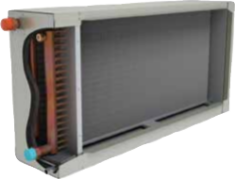
There are lots of ducted cooling applications with chilled water and/or DX (Evaporator) coils where you need to add incremental cooling to an existing system. However, there is an important difference when using heating coils. Because it’s a Cabinet Coilheating coil, there is no humidification occurring or water/condensate to draw. Due to these factors, cooling coils require a little more creativity and labor to install.

At Capital Coil & Air, we have removed all of the guesswork out of the application. Capital Coil manufactures Custom Coil Cabinet sections from as small as 12” x 12” sections to as large as 54” x 90” sections. We manufacture these units in both Chilled Water and DX (Expansion), as well as in 1/2” & 5/8” copper tube coils. You have the option to select anything from (3) rows to (8) rows. Additionally, we will custom-design the Cabinet around whichever site you select. Cabinet units include both insulation & drain pans, while the supports and casing allow you to connect directly to the ductwork. We can also add a Heating Coil inside the unit for more dehumidification if needed. Cabinet Coils are perfect for either heavy or light-duty installations.

All Cabinet Coils are available on Capital Coil’s Quick-Ship Program as well. As you are probably all-too-familiar, trying to custom design coils in the field is a pain. Using Cabinet Coils will greatly ease the whole installation process. Please see our Insulated Cabinet Coil Brochure for more details on available custom sizes.

Capital Coil & Air looks forward to the chance to your coil replacement specialists. Please give us a try on your next project!

RELATED POSTS

Chilled Water Coils & Moisture Carryover

New Product Offering: Insulated Cabinet Coils

Top 10 Chilled Water Coil Facts


The Smart Approach to Buying HVAC Coils (and Saving Money)

HVAC coil replacement does not have to be cost prohibitive. As you are all aware, money is tight these days, and budgets for maintenance and upkeep are constantly being cut. People are asked to do more with less, so every dollar spent must be spent wisely. In our previous newsletters, we have outlined various reasons about why you should do business with Capital Coil & Air. However, one of the most compelling reasons is cost and how you spend your money.

We now live in an age where you can skip “middle men” and buy direct from a manufacturer or supplier. Think about your own life and how your own personal shopping habits have changed over the years. When was the last time you used a travel agent to book a trip? In 2020, you’re much more likely to go to Tripadvisor or an airline’s website and make travel reservations yourself. Greater access to more choices gives you the opportunity to save money in the process.

Spending money in business these days is no different. Consumers have access to more information than ever before. Consumer studies show buyers get 60% of their product information from a firm’s website before ever speaking with a sales rep. The days of an account manager or manufacturer’s representative being the sole source of information are over. Right now, you can access Capital Coil’s website and see our entire HVAC product offering, including dimensions, quick-ship programs, and our Coil Selection Program. With information at the press of a button, Capital Coil’s expert customer service will consult with you to ensure that you’re getting exactly what you need, when you need it. Working with Capital Coil & Air directly cuts out that “middle man’s” costly mark-up and saves you money without sacrificing quality. Avoiding the “middle man” and having a direct line to the manufacturer also ensures quick response times, and helps to make sure that no information gets lost in translation.

Capital Coil & Air does have a select number of exceptional representatives in a few areas, and because they are valuable assets in the HVAC industry, we are comfortable passing your project information along to those representatives. But if not in one of those areas, you are free to work with us directly.

At the end of the day, technology has allowed you as the consumer to buy smarter, faster, and cheaper. Aside from those previously mentioned “middle men” who does not want faster and cheaper? Capital Coil & Air would like the opportunity to be your “direct supplier” on present and future projects. Give us a call and test us out!


RELATED POSTS

Top 10 Questions You SHOULD Be Asking Your Coil Supplier

Four Things That You Need When Buying Replacement Coils

Your Goals as a Buyer of Commercial HVAC Replacement Coils


Coil Costs: What Will Make Your HVAC Coils More Expensive?

We get questions all the time about how we build our HVAC coils, and what will add costs and what will not. This post will address the many inaccuracies other “mass production” manufacturers Hot Water Coilshave put out there. It’s very simple. There are only three areas on a coil that will add costs: the casing, the tubing, and the fins. Now we’ll deal with the many inaccuracies that most manufacturers try and “upsell” to you.

  • Connection sizes: There should be no additional cost switching from a 2” MPT connection to a 3” MPT connection. Only on rare cases with a 4” or 5” connection, should you ever see an adder in price.
  • Pitching the casing in a steam coil: All steam coils should be pitched. There is not some mysterious adder you need to pay to have you coil built the right way.
  • Casing depth and dimensions: Whether you want your coil 4” deep or 8“ deep, or want a 2” flange instead of a 1” flange, there should be no cost associated with simply more sheet metal.
  • Distributors on a DX Coil. This is our favorite. We actually had a call from a contractor who asked how much extra it was to get a distributor on his DX Coil. Distributors come standard with DX coils!
  • Flanges for “stackable” coils. This is just standard practice to meet the needs of your customer.

Coil Casing Adders: Most HVAC coils we manufacture are built with 16 ga. galvanized steel casing. We offer 3 other options that are slightly more expensive, but it all depends on your application if any of them are actually needed. Stainless steel casings are used in a corrosive atmosphere and are the most expensive option (even then, it’s only 10-15% more). 14 ga. galvanized steel casings are used primarily in coil banks where you might have between 2-4 coils stacked on one another. This adder for 14 ga. casing is only roughly 2-3% per coil.

Tubing Adders: There are many materials options in tubing and we offer all of them. Whether you need stainless steel, carbon steel, cupro-nickel, or standard copper tubes, we can build exactly what you need. Like any product, the more unusual the material, the more expensive the cost is. For most jobs with just copper tubes, adding a thicker tube wall will add only 10-15% in cost to the job and could double the life of your coil. For just a couple hundred dollars, that coil that would last 10 years could last 20. Some applications, like high pressure steam coils, require a thicker tube wall or more durable material or the life span of that coil will be extremely short. You’d be surprised at how many other manufacturers’ coils we’re asked to rebuild with the correct materials.

Fin Adders: Most coils are offered with aluminum fins with a thickness of .006”. The adders to go up in fin thickness are not much, but always remember, the thicker the fin, the more air pressure drop it’s going to add to your coil. The most costly adder you can do to a coil is adding copper fins. It will double the cost of your coil, and in some cases, be 2.5 to 3 times more expensive. This wasn’t the case 20 years ago, but the price of copper has risen over the last few years. We usually recommend coating your coils instead. It’s far more economical and only adds a week to the lead time.

Capital Coil & Air understands that people do business with you like and who you trust. Coil manufacturers should be an open book with this information. Unfortunately, most try and prey on what you don’t know. Hopefully, this helps with any confusion. Capital Coil & Air looks forward to working with you!

RELATED POSTS

Four Things That You Need When Buying Replacement Coils

10 Things You Need to Know to Buy Replacement Coils Effectively

The Smart Approach to Buying HVAC Coils (and Saving Money)


Quick, Reliable & Uncommonly Fast

 Quick, Reliable & Uncommonly Fast

You have many choices when buying replacement coils and choosing a coil supplier. You could decide to diversify and work with numerous suppliers, based on a particular need. However, Capital Coil & Air can make your buying decisions a lot easier. We have been in the coil business for many years, and in this industry, we recognize what is important vs. what is irrelevant. That translates into us having good insight on what you need and how best to support you as a customer.

Quick

Coils today typically do not have much “preventative” maintenance done on them. Most everybody just waits until a coil fails and then worries about the problem at that time. And when coils inevitably fail, they fail during the times when you need them most; i.e. cooling coils failing in the summer and hot water coils breaking down in the winter. As a result, there is usually an urgency attached to most HVAC projects. Generally speaking, most jobs require some form of “quick-ship”. Capital Coil & Air gives you (4) different shipping options for all replacement coils. Our standard ship time is 3 – 4 weeks, but if you need your order faster, Capital Coil will accommodate that need. We do not want to have a “one and done” transaction. Capital Coil’s goal as a business is to have a customer base that we work with for 20 years, not 20 minutes. While we will do our best to give you the fairest price possible, you have to recognize that there is an additional premium associated with quick-shipments on replacement coils. However, you will never pay that premium if Capital Coil is late on manufacturing your order. We’ve built our business on quick-ships, and we hit 99% of all deadlines on orders the last two years. In other words, we rarely miss! We give you options, and you only pay for what you really need.

Reliability

Reliability encompasses so many things in the coil industry. For example, if you need a price today, and the sales rep takes (2) days to get back to you, that’s unacceptable and unreliable. If you require a drawing to help you design a job, and you are waiting for a week to have it returned? Again, not what Capital Coil considers reliable. If a coil supplier promises you a ship date and ships (2) weeks late? Once again, not reliable. Do any of the above issues sound familiar? It is easy to make extravagant promises, and companies do it all of the time. However, Capital Coil’s success rate on meeting and exceeding shipping schedules says more than any promise we can make. We believe in under-promising and over-delivering, not the reverse!

  • Capital Coil responds quickly to all inquiries for pricing, general information, and engineering assistance
  • Capital Coil manufactures high quality equipment in the U.S.A. and is AHRI Certified
  • Capital Coil’s years of experience will help you quickly pick the correct product for the correct application
  • Capital Coil provides accurate shipping dates, real-time tracking and common carrier information after your order has left our factory

We do all of the above to make everything in your life easier. Capital Coil holds itself to the highest standards for both reliability and customer service. In short, we want your experience with us to be professional and simple. Please call or email our sales department for any job – no matter how large or small. We greatly look forward to the opportunity to work with you on your next project.

RELATED POSTS

Your Commercial HVAC Replacement Experts-Why Work With US?

Customers are a business top priority. So why is customer service such a challenge?

Large enough to service all of your replacement coil needs, but small enough to care about what you think


Does Your HVAC Coil Selection Program Leave You With More Questions Than Answers?

At Capital Coil & Air, we have an accurate and user-friendly coil selection program to select and choose coils. Of course, making good selections is based on having years of experience working with coils of all types and sizes, and Coil Selection Programwe at Capital Coil have that necessary expertise.

When designing a coil, the object is to balance cost and performance together, and that is one area in which we can greatly assist. We do not always choose the cheapest coil because the cheapest coil in almost never the best coil. There are always pressure drops, materials of construction, performance requirements and a host of other things that all play into good or bad coil selections. These are even more relevant in the coil replacement market!

The object is not to duplicate a problem with a coil, but to instead solve the problem and make the coil perform better and last longer. This requires problem solving and making selections that are not always “in the box”.

Part of any successful selection process is having a good selection program to help you. But what makes a program good? First and foremost, you must get the correct results, or you have bad information that is also useless. But apart from that, the selection program must be easy to navigate through. There are “red lights” and “stop signs” built into the program to keep you from making bad selections. Our selection program has most, if not all, coil configurations and styles that you’re likely to run across. We are confident that you’ll find the selection program user-friendly, helpful, and one that makes you want to do business with Capital Coil & Air.

You simply have to click here to request the program, and we will send you an email in response with an activation code and a link to download the program. Of course we are always here to assist you in any selections that you make, or to give you some engineering suggestions and recommendations. Thanks for giving us the opportunity to help you!

RELATED POSTS

10 THINGS THAT YOU DON’T KNOW ABOUT CAPITAL COIL & AIR

10 Things You Need to Know to Buy Replacement Coils Effectively

Repair or Replacement Coils?


Stock Hot Water Coil – Quick Buyers Guide

Hot Water Coils

Depending on the specific project, selecting the appropriate Hot Water Coil can go one of two ways:  1) costly and complicated or 2) cheap and rather straight-forward. If you’re a representative or contractor reading this, you understand this fact all too well. And if you’ve dealt with us, you know that we much prefer going the second route rather than the first.  Considering the complexity of other types of coils, hot water coils should be as easy for to purchase and get delivered as they are for the manufacturer to build and keep in stock. So…why is it so hard to get your hot water coils shipped to where you need them when you need them?

Capital Coil & Air decided to create a quick buyers guide to when selecting and purchasing Stock Booster Coil Replacements :

  • First and foremost, you need to determine whether the booster coil needs to be 1 or 2 rows deep. Keep in mind that a 2 row booster coil will always generate substantially more BTU’s than a 1 row booster coil, but will also cause your air pressure drop to rise.
  • Generally speaking, booster coils are primarily installed someplace in the ductwork. If your duct size doesn’t match exactly with what we can build a good rule of thumb is to request your coils be built slightly larger than the ducts where they are going to be installed.
  • Booster coils are offered in sizes anywhere from 6” x 6” to 30” X 72”. Booster coils are 1 or 2 row coils that are available in 60 sizes.  Flanged or Slip & Drive casings are available on every size to meet your needs.
  • While most manufacturers claim they have “booster coils in stock”, and then ship in a week, we actually have (30) sizes in stock ready to ship the next day!

Whether you need (1) hot water coil or (200) hot water coils, Capital Coil & Air has the most competitive pricing in the business with the best lead times. Please see our Booster Coil Product Page. Most companies don’t want to bother with hot water coils.  No one does hot water coils better than Capital Coil & Air!

Related Topics

Stock Hot Water Booster Coils

Booster Coil Basics

Booster Coil FAQ’s


Construction Vs Performance: Need To Know Terminology

If you have ever dealt with commercial HVAC coils, you have probably come across numerous “industry terms” with little to no explanation as to what these terms actually mean. To further confuse you, some verbiage is specific to the actual construction of the coil, while others are only important when determining a coil’s performance. If you do not work with coils on a frequent basis, it is hard to decipher what exactly these terms are referring to. To help translate this industry verbiage, Capital Coil & Air has come up with a list/glossary of the most common and relevant terms that you are likely to come across on most coil jobs.

 Performance

  • AHRI (Air-Conditioning, Heating, and Refrigeration Institute): Developed industry standards for air conditioning, heating, and commercial refrigeration equipment. All of CCA’s coils are AHRI-certified, so you know you’re getting dependable quality and performance in every product.
  • Air Pressure Drop: Air Pressure Drop is a result of Flow Rate, Fin Type, Rows and Fins per Inch. In addition, on either Chilled Water or DX (Evaporator) Coils, the air pressure drop is affected by the condensate on the fin surface.
  • Airflow (CFM): Cubic Feet per Minute, which refers to the amount of air flowing across the coil. A typical cooling coil should produce between 400-500 FPM. You want to avoid exceeding 550 FPM on all Chilled Water & DX Coils. Too little airflow means your coil is not running at peak capacity, while too much airflow can result in excess water carryover.
  • Entering Air Dry Bulb Temperature: You guessed it! The sensible temperature of the air entering the coil.
  • Leaving Air Dry Bulb Temperature: The sensible temperature of the air leaving the coil. Why does this matter? If you are trying to replace and duplicate a coil’s performance, making sure that your new coil can meet or exceed the old coil’s leaving air temperature is a crucial factor.
  • Entering Air Wet Bulb Temperature: This temperature signifies the amount of moisture in the air entering the coil.
  • Leaving Air Wet Bulb Temperature: Conversely, this temperature refers to the amount of moisture in the air exiting the coil.
  • Total Capacity: The sum total of a coil’s sensible and latent capacities.
  • Steam Pressure: Only relevant to steam coils, the saturated steam pressure at the inlet of a steam coil. Steam pressure is usually relative to the steam coil’s total capacity.
  • Steam Condensate: Again, applies only to steam coils and is a measure of the condensate generated by that steam coil.

Construction

  • Casing Type: The supporting metal structure for tubes and the header. Different casing options include Flanged (standard), Slip & Drive, Inverted, Stackable, and Collared End Plates & End Plates only. Steam Coils require Pitched Casing to allow for adequate condensation drainage.
  • Casing Material: The coil’s casing can be made from a variety of different materials. Options include: 14 or 16 Gauge, Galvanized Steel; 304 or 316 Stainless Steel; Copper & Aluminum. Please contact us directly to see about options other than those listed.
  • Connection Material And Type: Standard connection types are MPT (Male Pipe Thread, threaded on the outside), FPT (Female Pipe Thread, threaded on the inside), ODS (Sweat Connections, no threads)
    • Water & Steam Coils: Copper MPT, FPT, (with options for steel MPT & FPT)
    • DX & Condenser Coils: Copper ODS normally
  • Circuiting/FeedsCircuiting is determined by the number of tubes in each row divided by the total number of tubes fed (or feeds). Feeds are also known as the number of parallel circuits in the coils. Always feel free to call Capital Coil’s sales department with any circuiting-related questions.
    • Water Coil: Enter the coil’s performance data into CCA’s coil selection program, and select the “auto” sizing option to determine the optimal number of feeds.
    • Condenser Coil: Since the condenser is a rating program only, the user must enter a value for the number of feeds. A good rule of thumb is to have approximately 8 – 15 psi refrigerant pressure drop in the condenser.
    • DX Coil: Enter coil’s performance data into CCA’s coil selection program, and select the “auto” sizing option to determine the optimal number of feeds.
    • Steam: Always a full or double circuit
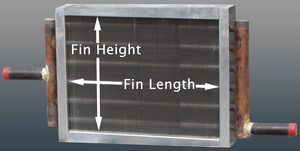
  • Fin Height: FH is measured in the direction of the fins, or perpendicular to the direction of the tubes.Water Coil
    • For 5/8″ tube coils, fin heights are available in increments of 1.5”
    • For 1/2″ tube coils, fin heights are available in increments of 1.25”
    • For 3/8″ tube coils fins are available in 1.00″ increments
  • Fin Length: FL is always measured in the direction of the tubes, regardless of which direction the tubes are running.
  • Fins per Inch: Represents the fin spacing on the coil. The number of fins per inch is an essential component when ordering a replacement. Using a standard ruler, simply count the number of fins per inch on the coil.
  • Number of Rows: Rows represent the coil depth and are always counted in the direction of the air flow, regardless of how the coil is mounted. Count the number of rows by viewing the header end or the return bend end of the coil.
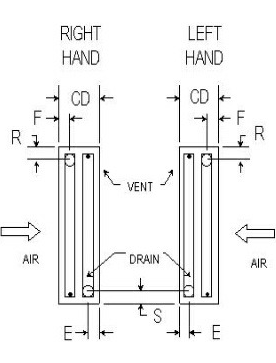
  • Hand (Left or Right): A coil’s hand is determined by the direction of the airflow. Look at the finned area of the coil, and if the air is hitting you in the back of the head, look to see which side of the coil the headers are located. If the header(s) are located on the right side, then the coil is right-handed. Likewise, if the header(s) is located on the left side, it is left-handed. An important point to remember is that you always want the airflow to run counter to fluids, refrigerant and steam flow.

Miscellaneous

  • Laminar Flow: Tends to occur at lower fluid velocities, below a threshold at which it becomes turbulent. In other words, laminar flow is smooth while turbulent flow is rough. Greater heat transfer occurs in a coil with turbulent flow as opposed to a calm, laminar flow.
  • Dry Weight: The estimated weight of the coil; not counting internal fluids or packaging.

RELATED POSTS

Tips on Hand Designation & Counter-flow

Coils and Counter-flow: 5 Common Questions

You should never have to worry about performance on replacement coils. Well…almost never!