If you need Trane replacement coil within a Trane system, but aren’t sure about the dimensions or decoding the model #, send this to Capital Coil & Air for pricing. On most Trane AHU’s, the AHU model #, as well as the coil or “part #”, is listed as “Service Model No Coil”. If you see this, send it over, and the sales team at Capital Coil will handle the rest. Great pricing with the ability to be built as fast as is needed!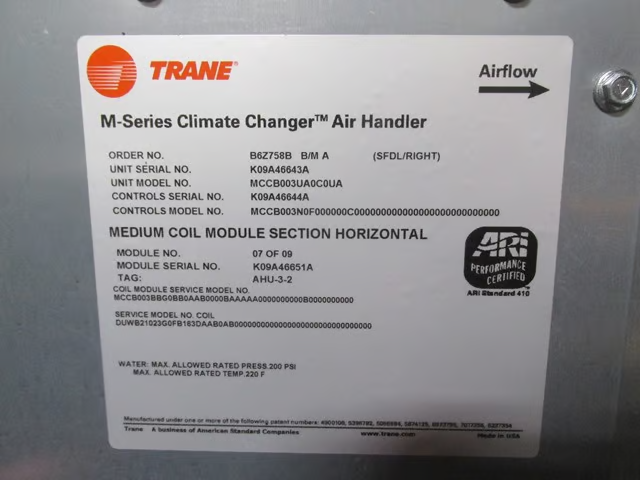
Top 5 Reasons Commercial HVAC Coils Prematurely Fail
Capital Coil & Air has come across virtually every scenario over the years in which a commercial HVAC coil had to be prematurely replaced, and we have since created an easy guide targeting the main reasons HVAC Coils prematurely fail.
- Coil Plugging: If you are not changing filters and/or your commercial HVAC coils are not properly cleaned in a timely manner, your coil will actually begin to act as a filter. When dirt builds up on the coil, that blockage prevents heat transfer and can cause an approximate 20% to 40% drop in performance. Dirt adds to the coil resistance and can be a primary cause for your coil to fail prematurely.
- Vibration: When your HVAC coils are installed near a moving piece of equipment, vibration can occur and cause leaks. You can tell if vibration is the main cause if leaks are near the tube sheet and look like they are slicing through the tube. If/when that happens, the coils should be isolated from the rest of the system to prevent vibration from causing damage. One way to combat this is by oversizing the tubesheet holes, but many manufacturers will not do this. Condenser Coils are usually the most common victims of vibration.
- Corrosive Environment: This applies to both the air in the environment and inside the tubes. For instance, if there is a corrosive element in the air, it will eat away at the copper tubes; whether you have 0.020” wall or 0.049” wall. This is very common in coastal areas where there may be salt in the air. To keep the costs down from going to a stainless steel or cupro-nickel coil, we usually suggest coating the HVAC coils. Coatings are almost always within your budget, and its application will only add about a week to the overall lead time. Steam condensate and untreated water can cause corrosion within the tubes of HVAC coils as well. If you have a steam coil that has failed before the one year warranty, there’s a great chance that corrosive agents are in the steam, and it’s eating away at the copper tubes.
- Freeze-Ups: Most people think that when HVAC coils freeze, the water or condensate laying in the coil freezes into ice and it expands causing the tubes to bulge and eventually spring leaks. What really happens is that the coil will freeze in multiple areas simultaneously, and it’s the pressure between these areas that cause the tubes to swell and eventually burst. These are very easy to spot as the leaks will run the length of the tube rather than around the tube. ALSO be very careful when considering “freeze-proof” coils! If you remove 5-6 inches from the fin length to make the “freeze-proof” application fit, your coil’s performance will suffer considerably.
- System Design: You would be amazed to learn how many HVAC coils were never designed properly for their systems. If there is a design problem, replacing the coil will only waste time and money; while you have done nothing other than duplicate the previous problem. A little known fact in the replacement market is that a high percentage of all our projects are because the coils were built incorrectly or were never designed correctly in the first place. In some cases, owners attempt to improve the coil’s performance by adding additional rows. Most however do this without taking into account the air pressure drop or fluid pressure drop that comes with it.
When dealing with an HVAC coil manufacturer, try to partner up with one who will walk you through the engineering and explain it along the way. Capital Coil & Air has well over a decade of experience and can help you diagnose whatever problem that you are experiencing correctly the first time. We look forward to working with you on your next project!
RELATED POSTS
Four Things That You Need When Buying Replacement Coils
Different Types of Steam Coils
There are two types of steam coils: standard steam coils, which are used in most reheat applications, and steam distributing coils, which are used in applications where the entering air temperature is below 40 F degrees. Many times, this type of coil is also known as a “non-freeze” coil, but that name is misleading because in reality, there is no such thing as “non-freeze”.
Standard Steam
Standard steam coils operate a lot like hot water coils, but the construction is very different even if the coils appear to be constructed the same. The supply and return connections are often on the same end like a hot water coil. But, steam is very different than hot water, and the coil must be built for and circuited for steam. Keep in mind that steam is always more erosive than hot water. The brazing and tube wall thickness must account for steam. ALWAYS remember that even low pressure steam is more erosive than hot water, and a steam coil needs to be built accordingly.
Steam Distributing (Non-Freeze)
Steam distributing coils are a completely different type of coil because they are constructed as a tube within a tube. Every place that you see an outside tube or header, there is an inside tube and header that you can’t see. The steam on the inner tube keeps the condensate in the outer tube from freezing. The purpose of the 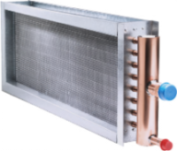 original coil design was to distribute the steam evenly along the length of the coil and to eliminate any dead spots on the coil. A byproduct of this coil was also found. The coils didn’t freeze nearly as easily as the standard steam coil, so the coils became known as “non-freeze”, which as mentioned, is not completely accurate. Any coil can freeze under the right conditions, but, this design is what needs to be used when the entering air is under 40F degrees!!!
Steam Coil Design
Steam coil designs can be very tricky. Steam coils are totally a function of the system and installation, while other coils operate more independently of the system. There needs to be correctly designed traps, and they need to be installed in the correct place and depth in the system. Often, vacuum breakers are also needed in the system. The piping must also be installed correctly to make sure the steam is entering the coil and not the condensate. Even with all of those factors, you’ll need a correctly designed steam coil that matches the steam pressure, length of the coil, and the entering air temperature. Coils can freeze easily. Coils can be too long in length and the steam cannot travel the length of the coil and distribute evenly. Condensate can easily be trapped somewhere in the coil, and the result is water hammer.
Capital Coil & Air has years of experience designing steam coils, and is here to answer any questions and help to design the right coil for your project!
Related Topics
Frozen Steam Coils: How to Prevent it!
Commercial Steam Coils; Lengths & Controls
HEATING SEASON WILL SOON BE UPON US
Chilled Water Coils – Circuiting Made Easy
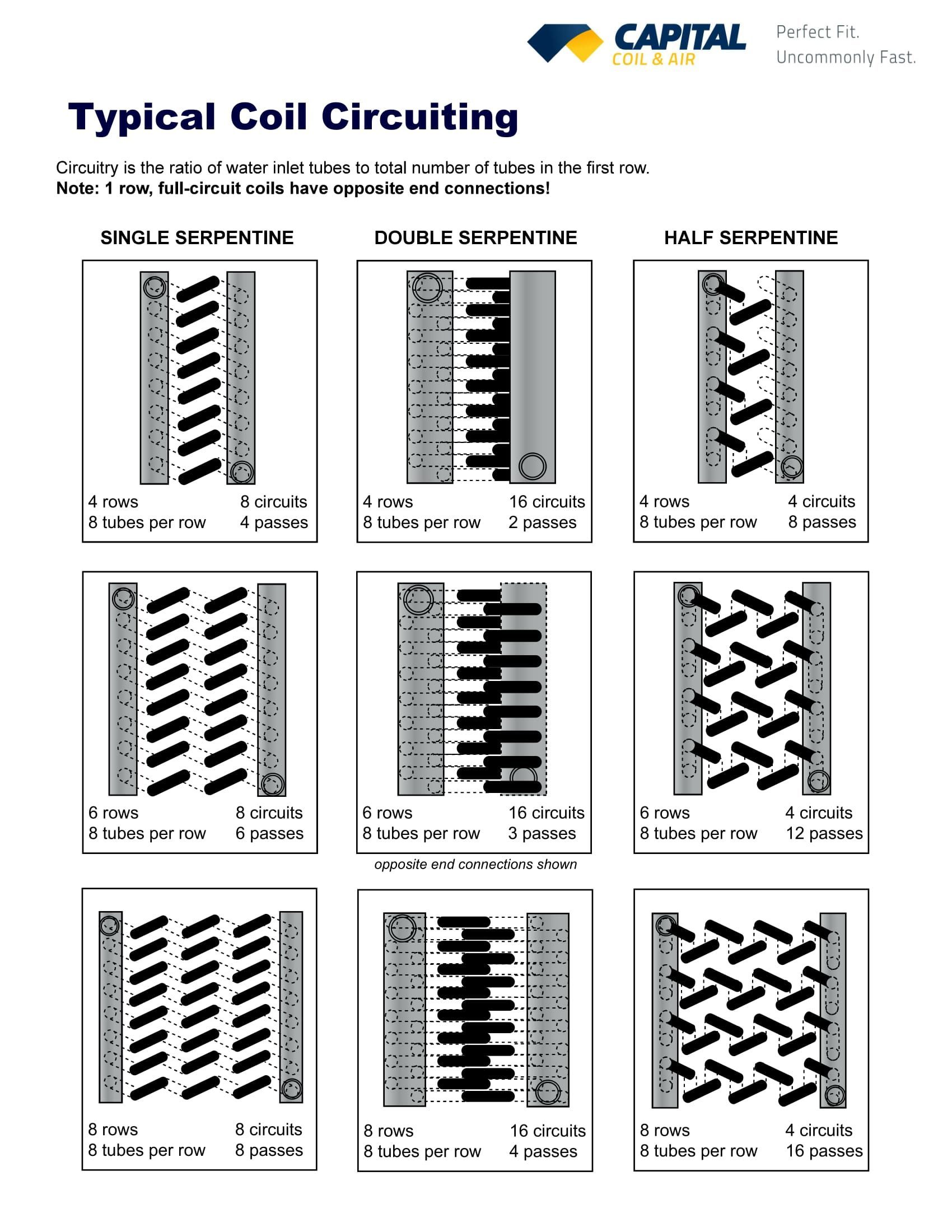
Circuiting chilled water coils is one of life’s great challenges in the coil business. You’re bound to run across folks with years of experience in the industry that can not effectively explain this concept. While not the most exciting of subjects, the necessity of circuiting chilled water coils can not be overstated. Capital Coil & Air has attempted to simplify the idea of circuiting as much as possible.
For starters, circuiting chilled water coils is ultimately up to the performance of those coils. Circuiting is really a balancing act of tube velocity and pressure drop. In other words, think of a coil as a matrix. Each coil has a specific number of rows, and a specific number of tubes within each row. For example, a chilled water coil might be 36 inch fin height and 8 rows deep. The coil has 24 tubes in each row, and multiplied by 8 rows, there is a total of 192 tubes within the coil. While you can try to feed any number of tubes, there are only a few combinations that will work.
-
- Feeding 1 tube – you will be making 192 passes through the coil, which will essentially require a pump the size of your car to make that process work.
-
- Feeding 2 tubes – equates to 96 passes, and your pressure drop will still be enormous.
-
- Feeding 3 tubes – 64 passes, which is still too many.
-
- Feeding 4 tubes – See above.
-
- Feeding 5 tubes – Impossible as 5 does not divide evenly into 192 (passes).
-
- Feeding 6 tubes – Still constitutes far too many passes, which again leads to additional pressure drop.
-
- Feeding 7 tubes – Same rule for feeding 5 tubes.
-
- Feeding 8 tubes – Same rule for feeding 6 tubes.
-
- Feeding 24 tubes – This feed consists of 8 passes, which is in the ballpark, and with a pressure drop you can live with.
-
- Feeding 32 tubes – 32 tubes will see 6 passes. You might see a slight decrease in performance, but it’s off-set by a continuously better pressure drop.
- Feeding 48 tubes – The magic combination, as 4 passes typically elicits the best performance and pressure drop simultaneously.
Rule #1: The number of tubes that you feed must divide evenly into the number of tubes in the chilled water coil.
Rule #2: The chilled water coil must give you an even number of passes so that the connections end up on the same end.
Rule #3: Based on the number of passes, you must be able to live with the resulting pressure drop. Acceptable tube velocity with water is between 2 and 6 ft. per second.
You’re bound to run into different terminologies depending on the manufacturer. More times than not, the different verbiage confuses more than it clarifies. However, understanding the basic tenets of chilled water coil circuiting will remove much of the perceived difficulty.
Related Posts
Coils and Counter-flow: 5 Common Questions
Top 10 Fan Coil FAQ’s
1. A fan coil is among the easiest units to understand in the HVAC industry. Basically, there is a small forward curved fan, a coil, and sometimes a filter. They are all direct drive units. Click HERE to see Capital Coil’s full Fan Coil Product Lineup.
2. Fan coils run from 200 CFM to 2200 CFM, which is 0.5 ton through 5.5 tons. Anything larger than these sizes requires a belt drive unit…which is really a full fledged air handler.
3. The thing that differentiates fan coil units is where and how they are going to be installed. Is the unit going to be hidden above the ceiling or maybe in a closet? Or is it going to be exposed so that everyone can see it? Will it be ducted or will it just pull air from the space where it’s located? These are things that determine the configuration of the unit and which style of unit to choose. But, every unit has 3 things in common: fan, coil, and sometimes a filter.
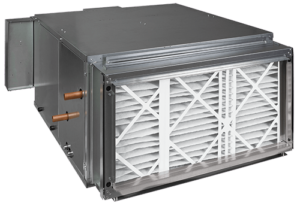 4. Some units have (2) coils. One for heating and one for cooling. Obviously, there is a separate supply and return connection for each coil and these units are known as 4 pipe fan coils. Many units only use the same coil for both heating and cooling and these units are 2 pipe fan coils.
5. Units are either horizontal or vertical depending on the orientation and flow of the air. A typical fan coil in a hotel room is a vertical unit with a mixture of air coming from outside and the air recirculating in the room. The air enters at the bottom of the unit and is drawn upward through the fan. This makes the unit a vertical style. Many units are horizontal with the air entering at the back of the unit and traveling horizontally through the unit.
6. Almost all fan coils are 3 speed or infinite speed settings based on the controls. The high speed gives you more BTU’s, but more noise too. Because the unit is direct drive, when you dial down the speed, you also dial down the performance.
7. Coils in the units tend to be 3 or 4 row deep coils. 3 row is typically used the most, but if you need the extra performance, 4 row is the way to go. Performance is always governed by the cooling aspect.
8. Fan coils sometimes have short runs of duct work and there is static pressure on the unit. Static pressure reduces the amount of CFM and BTU’s that the fan coil can give you. This is true of both horizontal and vertical units. Most performances listed on charts that you will see are static free performances.
9. The control systems for fan coils are often more complicated and more expensive than the units themselves. There are balancing valves, isolation valves, unions, y-strainers, p/t plugs, air vents, ball valves, thermostats, condensate float switches, and disconnects. Capital Coil & Air can do this at the plant, but it is much cheaper and easier to do it at the installation.
10. Just describe your installation requirements to a sales engineer at Capital Coil & Air and they will guide you to the right design and configuration of the unit for you. It requires only a phone call or e-mail! We look forward to working with you!
RELATED POSTS
Top 10 Chilled Water Coil Facts
What Is Meant By A “Bank” Of Chilled Water Coils
For those that work with HVAC installations on a regular basis, you have run across the problem of needing to install new chilled water coils in very tight, confined areas. The coil is too big to fit in the 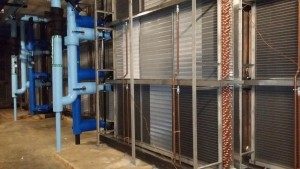 elevator, and/or the HVAC room is so small that you are likely to damage the coil simply by moving it. As a solution to this challenge, chilled water coils are often installed in “banks” of coils. You are most likely to see this configuration in Air Handler Units, as well as “built-up” systems. Due to face velocity limitations across the coil, you will need larger coils in order to meet your required face area. With this in mind, there are a few specific reasons why you want to avoid having a single, large coil in one of your units. Starting with the obvious: larger coils are much more difficult to transfer and install. This is especially true for older buildings, where the rooms were essentially built around the HVAC system.
As you’ve probably experienced, some of these areas can barely fit a single person, so installation – if even possible – is a logistical nightmare. Also, the larger the coil, the easier it is to damage during transport to the jobsite. To avoid these issues, simply break down the single, larger coil into smaller coils. When piped together, those smaller coils are stacked into “banks” of coils in the system. If installed correctly, this “bank” should have the same performance as the larger, single coil.
Casing
There are many different casing options available, but “stackable” flanges are required for heavy chilled water coils that are “banked”. The flanges are often inverted inward and down to give added strength to the casing, which is needed due to the fact that another coil of equal weight will be stacked on top of it. When ordering coils in a “bank” configuration, be sure to let the manufacturer know that they will be “stacked”.
Many engineers also use stainless steel casings on chilled water coils. While more expensive than traditional galvanized steel, stainless steel protects against excessively wet coils and/or corrosive elements in the airstream. Keep in mind that the majority of coils fail because of old age and its casing, as opposed to failure with the coil’s core. With that in mind, doesn’t it make sense to select heavy-duty stainless steel casings that are more durable and meant for stackable installations?
Drain Pans & Water Carryover
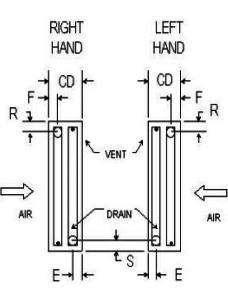
All chilled water coils must be sized so that the face velocity across the coil does not exceed 550 ft/minute. Water on the outside of the coil is carried away from the coil’s leaving air side in an arc, while water in the highest point of the coil is carried further down the unit or ductwork. “Stackable” coils often require intermediate drain pans under each coil to catch the excess water carryover. Each coil in a bank requires its own drain pan, as a single, large pan under the bottom coil is not enough.
Circuiting/GPM
If all of the coils in a “bank” are of equal size and handling the same CFM, then the GPM of each coil will also be the same.
Always feed the bottom connection on the supply header on the leaving air side of the coil. This ensures counter air and water flow. This also prevents the coil from short circuiting because the header fills first and circuits all of the tubes equally.
Designing Banks Of Coils
Almost all coil “banks” perform more efficiently if you design something more square in shape, as opposed to long and/or high. In a “bank” of coils, you may find that one coil has points of 300 ft/minute, with other points at 800 ft/minute. Scenarios such as this will cause water-carryover! You generally want to be as close to 550 ft/minute as possible in order to allow equal airflow distribution across the face area of the coil.
Anytime you are designing and/or building coils, work closely with the manufacturer as an added resource to ensure that you are getting the ideal solution for your HVAC system. Capital Coil & Air works on similar jobs such as these daily, and we welcome the opportunity to work with you in whatever capacity is needed.
RELATED POSTS
Top 5 Reasons HVAC Coils Prematurely Fail
Top 10 Tips For Measuring HVAC Coils
1. When measuring HVAC coils, performance has very little to do with accurately measuring for replacement coils. Fitting the coil in the existing space with the least amount of labor has everything to do with measuring a coil. If you duplicate the coil in almost every respect, the performance will match and take care of itself. New is always more efficient than old.
2. If you’re ever in doubt about a dimension, smaller is always better than bigger. You can always “safe off” around any coil as long as you can fit it in the space. If a coil is too big, it makes a really ugly coffee table in your shop. Too big is the enemy of measuring coils.
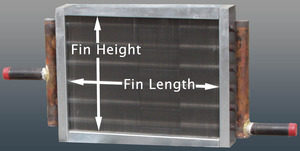
3. The fin height and fin length are not the determining factors in measuring a coil. The overall casing dimensions are the most important, and you work backwards to determine fin dimensions.
4. The depth of any coil is the total casing depth in the direction of airflow. The height is the number of tubes high in any row. Depth is a function of rows deep and height is a function of tubes in a row.
5. Overall length (OAL) is not the fin length and it’s not the casing length. It is the length from the return bends to include the headers that are inside the unit. Again, it is necessary to work backwards to get the other dimensions once you know this critical dimension.
6. Circuiting is the number of tubes connected to the supply header. Generally, you just want to count the number of tubes connected to the header and that will tell you whether it’s full, half, or even a double circuit. It does not matter how the return bends are configured. Your goal is to count the number of supply tubes and all performance is based on that.
7. Fins are measured in fins per inch. Hold a tape measure up to the coils and count the number of fins in one inch. If you can’t get in to take the measurement, a safe rule of thumb is 10-12 fins/inch. That will work on almost every coil. The exception to that rule is a condenser coil. 14-16 fins/inch on a condenser coil is usually pretty safe.
8. Connection locations are difficult only if you are using the existing piping in the system (which are welded). Copper piping is brazed and can be changed easily. If a system is old and the piping is being replaced as well as the coil, the connection location is not a major deal. It’s very easy to match up!
9. With replacement coils, the concept of “left hand vs. right hand” doesn’t actually exist. Connections are “top left-bottom right” or vice versa. Ideally, all coils should be counter-flow which means that the water and air flow in opposite directions. The air hits row one first and the water is piped into row eight first. However, there are lots of installations that are piped backwards, and they work just fine. Just match them up, and the coil’s performance will be equal to the old coil.
10. Connections are not measured from the top of the header! They are measured from the top of the casing to the centerline of the connection. Or the bottom of the casing to the centerline. You need a point of reference, and the header height can be anything just as long as it doesn’t stick above or below the casing height.
All of the above “suggestions” or “secrets” are in no particular order. They are just things that you should know to ensure that you are selecting the correct replacement coil. While most seem like common sense, your best bet is to talk with the sales team at Capital Coil & Air, who can walk your through the entire process and help you to fill out coil drawings when trying to measure the dimensions.
RELATED POSTS
Replacement HVAC Coils: 10 Common Ordering Mistakes
Case Study – Replacement DX Coils at local Mushroom Farms
Replacement DX Coils: To those not aware, Kennett Square, PA is the mushroom growing capital OF THE WORLD! Kennett Square is also located quite close to Capital Coil’s sales office in West Chester, PA, and we get multiple requests per month to personally come out and measure DX coils that need to be replaced at these farms.
Mushrooms need a well-ventilated growing environment, and poor ventilation can lead to higher levels of CO2. Higher CO2 levels negatively affect mushroom quality and growth. Ensuring proper air circulation is essential for maintaining healthy crops. Mushrooms also thrive in high-humidity environments, but excessive moisture can also lead to mold or bacterial growth, which can damage the entire crop. Proper humidity control is crucial to maintaining the right balance and preventing costly losses. To tackle these problems, growers need reliable climate control systems, and that’s where Capital Coil steps in.
Mushroom cultivation, while lucrative, is not without its challenges. Running climate control systems for mushroom farming can be expensive, especially when using inefficient equipment. High energy costs can eat into profits, particularly for smaller, family-owned operations. One of the biggest challenges for mushroom farmers is making sure that the coils are working at peak efficiency because the conditions in and around those farms will corrode the aluminum fins at a faster pace than most other environments. As mentioned above, there are very specific conditions that need to be maintained for a successful crop, so the coils in the condensing systems that are needed to sustain those conditions have to be working at all times.
One farm had been trying to repair numerous coils through different “band-aid” methods. None of these attempts worked, and the farm’s energy costs had skyrocketed when trying to get the same capacity from a failing coil. One of the neighboring farms that had used us for numerous DX coil replacements recommended that they call Capital Coil to come out and assess the failing coils.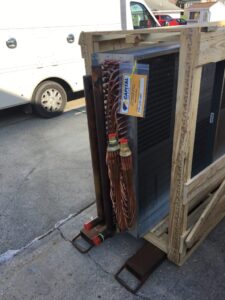
After looking at a few of the units, most of the coils’ finned area had been eaten away by corrosive elements in the air. The OEM had not recommended any protection for the coils, which was why they failed far sooner than they should have. The new coils were to be installed in the original units, so the measurements needed to be exact. I also explained to them that any new coil(s) needed to either have more durable materials, such as stainless-steel casing and/or copper fins, or a protective coating for the whole coil. If not, these same issues would continue to occur.
The farm decided to order (1) DX coil with an epoxy coating as a “test” before ordering the rest. The new DX coil arrived a few weeks later and was a perfect match for the original unit. A year later it was still running at max capacity with zero damage to the finned area because of the coating.
Due to the speed that we were able to come out to the site, correctly assess the reasons for the coil failures, and make recommendations on increasing the coil’s longevity, they decided to order the remaining batch of DX coils from Capital Coil & Air. They also recommended us to many of the other farms in the area, so Capital Coil is now the main HVAC coil replacement company for many of the largest mushroom farms in the United States.
RELATED POSTS
OEM Replacement Coils: Repair or Replace
Why are HVAC Coils Copper Tube and Aluminum Fin
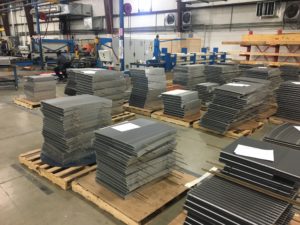 It’s really not a coincidence why HVAC coils use copper tubes and aluminum fins. Copper is great for heat transfer, and aluminum – while still very effective -is simply not as good. The first goal of any HVAC coil is to cool or heat. Heat transfer is always the first consideration. Cost is the second. Copper works well for the tubes, but would be prohibitive for the fins. You would need a compelling reason for the fins to be copper, and sometimes there are reasons to do just that. However, the vast majority of HVAC coils that you see are built with copper tubes and aluminum fins. That combination offers the most effective heat transfer at the most efficient cost.
To begin, fins are responsible for a surprising 65% – 70% of the heat transfer on any coil, while tubes are responsible for the remaining 30% – 35%. Additionally, in order for your coil to work at optimum performance, you need to have a terrific fin/tube bond. Fins are known as secondary surface, while tubes are referred to as primary surface. While this may seem counterintuitive, the secondary surface is responsible for twice the amount of heat transfer as the primary surface.
The tubes are expanded into the fins, and for that reason, the fins become secondary. As mentioned above, the fins are responsible for 65% – 70% of all heat transfer that takes place in the HVAC coil. When you think about it logically, it really makes sense. At 8 fins/inch or 10 fins/inch, and with fins that run the height and depth of the coil, there is much more fin surface than tube surface. However, it also points out how good the fin/tube bond must be in the expansion process. Without that bond, the fins cannot perform their job.
Understanding the role and importance of the materials used in HVAC coils cannot be overstated. There is a distinct reason why the vast majority of coils are constructed using these materials. While coils can be built with other tube materials, such as steel, 304/316 stainless steel, 90/10 cupro-nickel, as well as various different fin materials, none of these are as efficient or economical as copper/aluminum.
Capital Coil & Air is here to help you with any and all coil selections, and we look forward to working with you on your next project.
RELATED POSTS
Top 10 Chilled Water Coil Facts
Every Chilled Water Coil selection is about balance. Your coil selection balances the rows/fins versus the cost of the coil pressure drops/performance. Trying to cut corners on your initial selection may save you money upfront, but you will inevitably pay it back down the line through added energy costs. This is a truism for every manufactured coil.
- Fins cost less money than rows/tubes. A good cost-cutting tool when selecting a coil is to choose 14 fins/inch. This will turn your (8) row coil into a (6) row coil, which will dramatically lower your costs. If you choose to go this route, one thing to keep in mind is that 14 fins/inch will be semi-inconvenient to any maintenance crew tasked with cleaning the coil. Don’t expect a Christmas card from them that year.
- That raises the question of whether or not you can even clean a deep (6) or (8) row coil? In short, you can, but it is not easy. Chilled water coils are especially difficult to clean because they are almost always wet. Due to this fact, they typically attract dirt and additional particles that other coils do not. Generally, when cleaning a coil, most of the dirt get pushed to the middle, and for that reason, 14 fins/inch may not be the best idea after all.
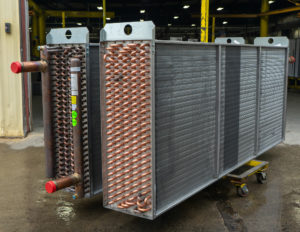
- Did you know that fins do approximately 70% of the heat transfer in a chilled water coil, while the tubes are only responsible for the remaining 30%? This is precisely why the fin/tube bond is so important. Without a perfectly crafted fin/tube bond, coils become inefficient very quickly. You pay for that inefficiency through increased energy costs.
- How long does a coil last? At what age can I expect my coil to fail? Unfortunately, there is no single answer to either question. Everything is dependent on a combination of maintenance, duty, and numerous other factors. If your initial selection was correctly chosen, and proper maintenance was kept, 15-20 years is a good timeframe.
- You may have a situation where your coil is 20 years old, and everything appears to be operating in good condition. There are no leaks and all looks ok. However, over that length of time, what you don’t see is that the fins have thinned and are no longer bonded to the tubes, and the coil is dirty in places that you cannot see. Again, while the coil may look to be running in top form, it’s probably only running at 60% capacity. Most likely, the tubes have also thinned over time, so when the next deep freeze occurs, you can guess the likely outcome.
- You really need to replace the coil, but have been told to make do with the current coil? To make up for the lack of efficiency, you might try to “jury-rig” your system. One method is to change the drive on the fans to deliver more CFM. This increases the air pressure drop, which in turn increases motor brake horsepower. Another option to help increase the coil’s efficiency is to lower the temperature of the chilled water from the chiller. We tend to mess with the system and apply temporary Band-Aids, when replacing the coil is the only guaranteed long-term solution.
- If you want to spend money wisely on a chilled water coil, simply make the tubes thicker. The tube thickness for a 5/8” tube coil is .020” thick, so increase the tube thickness to .025”. The same applies for a ½” tube coil, with a tube thickness of .016”. Increase it to .020”. By doing this, you get the added bonus of making your return bends thicker, which also helps to extend the life of the coil.
- Not quite sure about circuiting on a chilled water coil? You are going to have a hard time making an accurate selection unless you understand how to circuit a coil. Circuiting is really nothing more than selecting the number of tubes that you want to feed, and how many passes the water makes through the coil – depending on your GPM. Circuiting is one of the most important factors in ensuring that your coil is running at peak-performance.
- Curious about the balance between cost, size, materials, and maintenance? Every chilled water coil needs to be maintained for its entire life-span. If you’ve made your selection, and something seems off about the coils, chances are mistakes were made during the selection process. Some indicators include the coil being too big for the space allowed, or incurring out of control energy costs. What is the point of saving $500 on a chilled water coil if you have to spend $5,000 in maintenance over its life-span?
As coil replacement experts, we run into this issue every day. Our goal is to work with you to ensure your selections are correct the first time. The person in charge of budgets will be grateful to you over time. Capital Coil & Air welcomes the opportunity to work with you on your next coil project! We want to be your coil replacement specialists.
RELATED POSTS
Chilled Water Coil Circuiting Made Easy