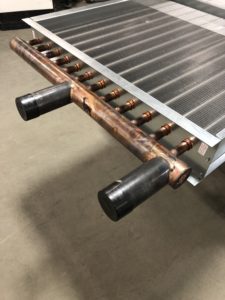
For those that work with HVAC installations on a regular basis, you have run across the problem of needing to install new chilled water coils in very tight, confined areas. The coil is too big to fit in the 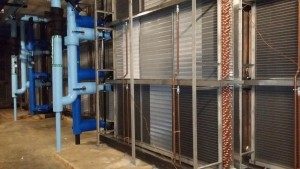 elevator, and/or the HVAC room is so small that you are likely to damage the coil simply by moving it. As a solution to this challenge, chilled water coils are often installed in “banks” of coils. You are most likely to see this configuration in Air Handler Units, as well as “built-up” systems. Due to face velocity limitations across the coil, you will need larger coils in order to meet your required face area. With this in mind, there are a few specific reasons why you want to avoid having a single, large coil in one of your units. Starting with the obvious: larger coils are much more difficult to transfer and install. This is especially true for older buildings, where the rooms were essentially built around the HVAC system.
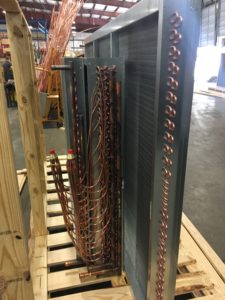
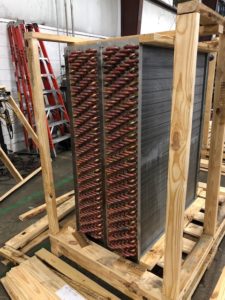
As you’ve probably experienced, some of these areas can barely fit a single person, so installation – if even possible – is a logistical nightmare. Also, the larger the coil, the easier it is to damage during transport to the jobsite. To avoid these issues, simply break down the single, larger coil into smaller coils. When piped together, those smaller coils are stacked into “banks” of coils in the system. If installed correctly, this “bank” should have the same performance as the larger, single coil.
Casing
There are many different casing options available, but “stackable” flanges are required for heavy chilled water coils that are “banked”. The flanges are often inverted inward and down to give added strength to the casing, which is needed due to the fact that another coil of equal weight will be stacked on top of it. When ordering coils in a “bank” configuration, be sure to let the manufacturer know that they will be “stacked”.
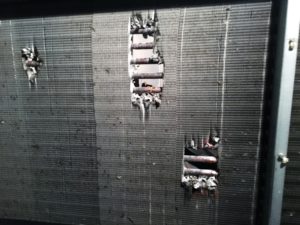
Many engineers also use stainless steel casings on chilled water coils. While more expensive than traditional galvanized steel, stainless steel protects against excessively wet coils and/or corrosive elements in the airstream. Keep in mind that the majority of coils fail because of old age and its casing, as opposed to failure with the coil’s core. With that in mind, doesn’t it make sense to select heavy-duty stainless steel casings that are more durable and meant for stackable installations?
Drain Pans & Water Carryover
All chilled water coils must be sized so that the face velocity across the coil does not exceed 550 ft/minute. Water on the outside of the coil is carried away from the coil’s leaving air side in an arc, while water in the highest point of the coil is carried further down the unit or ductwork. “Stackable” coils often require intermediate drain pans under each coil to catch the excess water carryover. Each coil in a bank requires its own drain pan, as a single, large pan under the bottom coil is not enough.
Circuiting/GPM
If all of the coils in a “bank” are of equal size and handling the same CFM, then the GPM of each coil will also be the same.
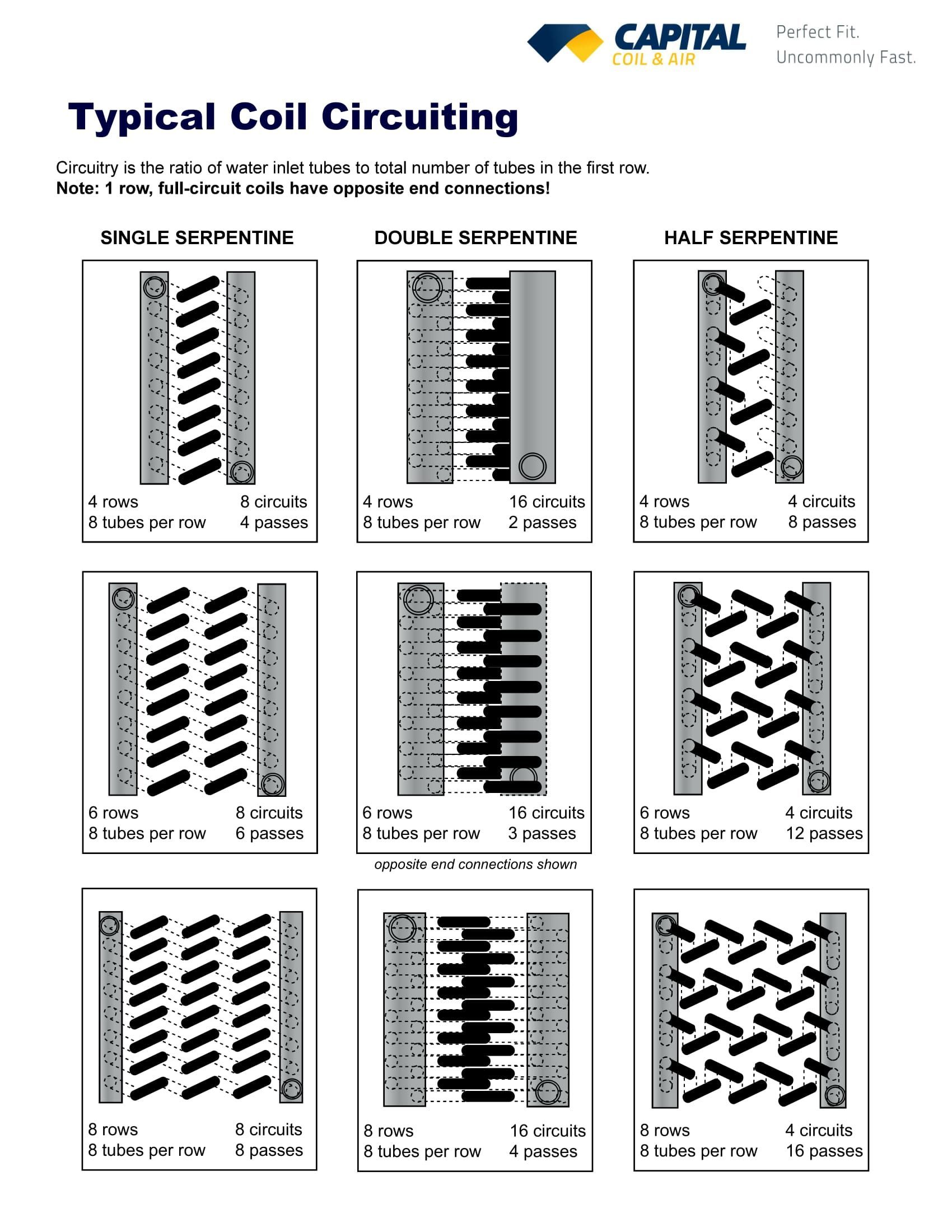
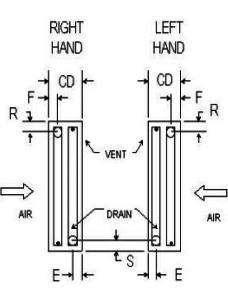
Always feed the bottom connection on the supply header on the leaving air side of the coil. This ensures counter air and water flow. This also prevents the coil from short circuiting because the header fills first and circuits all of the tubes equally.
Designing Banks Of Coils
Almost all coil “banks” perform more efficiently if you design something more square in shape, as opposed to long and/or high. In a “bank” of coils, you may find that one coil has points of 300 ft/minute, with other points at 800 ft/minute. Scenarios such as this will cause water-carryover! You generally want to be as close to 550 ft/minute as possible in order to allow equal airflow distribution across the face area of the coil.
Anytime you are designing and/or building coils, work closely with the manufacturer as an added resource to ensure that you are getting the ideal solution for your HVAC system. Capital Coil & Air works on similar jobs such as these daily, and we welcome the opportunity to work with you in whatever capacity is needed.
RELATED POSTS
Top 5 Reasons HVAC Coils Prematurely Fail