What Does “Splitting” DX (Evaporator) Coils Mean

***Now Offering R-454B Refrigerant for All DX Coils

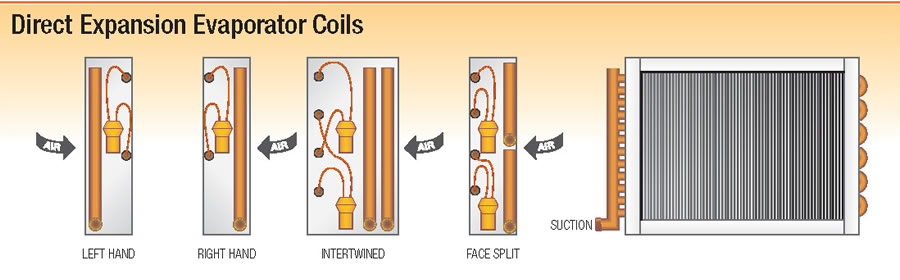
“Splitting” DX (Evaporator) coils is one of the toughest concepts to understand in the coil business. “Splitting” the coil simply means that (2) or more compressors can operate off of the same coil. One obvious advantage, or reason that you might “split” DX (Evaporator) coils is that you can shut down (1) of the compressors when the cooling load does not require it. This in turn saves energy, which saves $ when the cooling load is not operating at maximum design conditions. For example, let’s use a coil that is designed to give you (40) tons, but the coil is split so that (2) 20-ton compressors are feeding the same coil. If you only require ½ of the maximum load on any given day, you can shut down (1) compressor completely and operate the other one at 100%. This is a money-saving feature that you need to be aware of if you deal with DX coils on a regular basis. This requires special circuiting arrangements, and this is where the confusion starts with most folks. There are three primary ways to deal with this:DX (Evaporator) Coils
FACE SPLIT

Splitting the coil is nothing more than putting (2) completely separate fin/tube packs (coils) into one common casing. When you hear the term “face-splitting” a coil, you are drawing a horizontal line from left to right across the face of the coil and dividing the coil into a top and bottom half. It is like having two separate coils in one casing in that each half is circuited by itself. You hook up (1) compressor for the top half, and (1) compressor for the bottom.

In practice, this configuration is no longer used with much frequency because this arrangement leads to air being directed across the entire face of the coil. This disadvantage is especially apparent when only one half of the coil is in use because you’ll need a complicated damper/duct system to ensure that air is only directed to that portion of the coil in operation.

Row Split

“Row splitting” a coil is dividing the coil by drawing a line vertically and putting some portion of the total rows in (1) circuit, while putting the remaining rows in the other circuit. With this configuration, the air passes across the entire face of the coil, and will always pass across the rows that are in operation.

Please be aware that this configuration also comes with certain issues in that this kind of split makes it very hard to achieve a true 50/50 split. Let’s use an (8) row coil as an example. You would like to “row split” this coil with (4) rows/circuit, which would appear to be a perfect 50/50 split. The problem here is that the first (4) rows, located closest to the entering air, pick up a much higher portion of the load than the last (4) rows. In actuality, this coil’s split is closer to 66% / 34%, which will not match the 50/50 compressors. Another option is try to split the coil between (3) & (5) rows. While not 50/50 either, this configuration is closer. However, a new challenge arises because you have now created a coil that is very difficult to build and correctly circuit. In short, you need almost perfect conditions along with a degree of luck to achieve a true 50/50 split using this method.

Intertwined Circuiting

The most common to split coils today is to “intertwine” the circuiting. This means that every alternate tube in the coil is included in (1) circuit, while the other tubes are included in the (2nd) circuit. For example, tubes 1, 3,5,7,9, etc. in the first row are combined with tubes 2, 4, 6,8,10, etc. in the second row. The same tubes in succeeding rows form (1) circuit. You are essentially including every alternate tube in the entire coil into (1) circuit, which (1) compressor will operate. All of the remaining tubes not included in the first circuit will now encompass the second circuit.

The advantage of this configuration is that the air passes across the entire face of the coil, and, if one of the compressors is on, there are always tubes in operation. Every split is now exactly 50/50 because it cannot be any other way. Most DX coils are now configured in this manner due to these advantages.

Capital Coil has been, and will remain, the most reliable source for all commercial and OEM replacement coils. Our #1 job is to make to your job easier, so please reach out. You will be glad you did.


RELATED POSTS

CHILLED WATER, DX (EXPANSION) COILS & MOISTURE CARRYOVER
Now Offering R-454B Refrigerant for All DX Coils

DX & Chilled Water Cabinet Coils


5 Work Day Quick-Ships on HVAC Coils – Why Capital Coil does it right

Day 1 – 38% of all orders sent to Capital Coil are on some kind of quick-ship, whether it be on a (5 day, 10 day, or 15 day). We enter the order immediately so that all departments in the plant have the project in their systems and are ready to move on it right away. The coil isQuick-Ships engineered, routing sheets are sent to the shop floor, and everybody now knows what needs to be built. 

Day 2 – Sheet metal casings are cut and sized, headers and connections are fabricated, while tube sheets are fabricated.

Day 3 – All tubing and fins are cut, stamped and assembly begins. You can see what the coil will look like upon final assembly at this point. Coils can be seen sitting on assembly tables.

Day 4 – Tubes are then expanded into the fins, and keep in mind that this is not a short process. Headers are then brazed to the tubes, and if there are return bends, they are connected. The coil is completely assembled and moved to the testing tank. The coil is tested under water for 20 minutes at 550 PSI. About 3% of coils have small leaks someplace in the brazing and are sent back to braze again.

Day 5 – The coil is crated and sent to shipping for routing to the customer. Then most importantly, your coil will be shipping in the guaranteed (5) days.

As you can see by this description, with quick-ships, there is not a lot of room for error in the timing and shipping with OEM HVAC replacement coils. We’ve been doing this for a while now, and we’ve had an approximately (97%) success rate fulfilling all quick-ship requests. We offer quick shipments 365 days per year, with both (10) day shipments & (15) day shipments also available for lower premiums.

diagram 

RELATED POSTS

Are Your Quick-Ships Shut Down When Needed Most???

How to make your HVAC OEM Replacement Coil Buying Process Easier??

OEM Replacement Coils: Repair or Replace???


Why Are Fin Designs On HVAC Replacement Coils Important?

Replacement HVAC Coils

At first glance, fin designs on HVAC replacement coils seem about as exciting as watching grass grow. “Why would I ever care about fin designs on any coil” was probably your initial response to our question. Nevertheless, we would not dedicate a newsletter to this subject if fins were not important.

One of the primary reasons fins are so important is that you want to keep your coil as clean and maintained as possible. In order to properly maintain your coil, you need to have an understanding as to how HVAC replacement coils are constructed. While fins do not look like much, they are MUCH more complicated than what you can observe at the entering or leaving airside of the coil.

To begin, fins are responsible for a surprising 65% – 70% of the heat transfer on any coil, while tubes are responsible for the remaining 30% – 35%. Additionally, in order for your coil to work at optimum performance, you need to have a terrific fin/tube bond, (which we will discuss below).

  1. Fins are known as secondary surface, while tubes are referred to as primary surface. While this may seem counter-intuitive, the secondary surface is responsible for twice the amount of heat transfer as the primary surface.
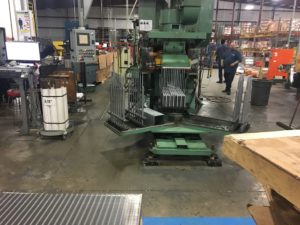
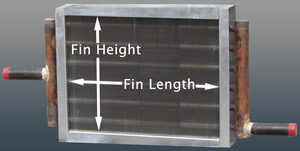
  2. There are special dies (see picture) that stamp out aluminum or copper fins with the correct thickness, height, and depth to make the coil the correct size. For example, a coil might be 36” (height) x 96” (length) x (8) rows deep x 8 fins/inch.
    1. Fin Height: 36”
    2. Fin Depth: 12”, (8) rows deep
    3. # of fins in the coil: 768 (8 fins x 96”)
  3. Each fin has 192 holes stamped in the fin for 5/8” OD tubes (8 Rows x 24 Tubes), and each fin is identical.
  4. Each hole has extruded metal, which is more commonly referred to as the fin collar. The collars are sized to self-space the fins and allow for later expansion of the tube into the fin collar. This practice is also known as “bonding” and is essential to having your coil run efficiently/correctly.
  5. Each fin is rippled at the entering and leaving edge of the fin to help create air turbulence.
  6. Each fin is corrugated in the direction of airflow to allow for greater air turbulence. This is important to remember because turbulence creates heat transfer.

So again, what is the point of understanding the importance of fins in HVAC coils? While coils can be built with flat fins for various reasons, the vast majority of coils are built with enhanced fins. Enhanced fins help to ensure that the airflow is not running straight through the coil.

Regardless of fin type, keep in mind that HVAC coils can and will act as great “filters”. The tubes are staggered and not in-line; while the fins are designed to help break up the airflow and not facilitate an easy, straight-through air path. Dirt and/or other particles in the air get caught easily, which again, is why coils can act as great filters. Additionally, coils with more rows will usually get dirtier than coils with less rows. Lastly, chilled water or DX coils are typically wet coils, which results in them catching virtually everything in the air.

The amount of BTU’s through any coil is in direct proportion to the amount of air through the coil. For example, if you are only getting 90% of the design air through the coil, then you are only getting 90% of the BTU’s.

Coils require good filtration and periodic maintenance. If not done correctly, you’ll pay the price of higher energy costs on an inefficient coil.

By now, you have hopefully come to the realization that HVAC coils are much more complicated than they appear, and that fins are an integral part of the coil as a whole. Again, while admittedly not the most exciting topic, understanding the role and importance of fins in HVAC coils cannot be overstated. Capital Coil & Air is here to help you with any and all coil selections, and we look forward to working with you on your next project.

RELATED POSTS

Repair or Replacement Coils?

Top 5 Reasons HVAC Coils Prematurely Fail

Are You Asking Your Coil Supplier These Questions?


Hot Water Coils & Heating Season

The real ability and competency in selecting hot water coils or any other heating coil is to know and understand the products that are available. Our goal here is to help simplify your selection process. Just as you’d spend time researching cars before a purchase, you want to be as educated of a buyer as possible!Hot Water Coil

HOT WATER COILS

The HVAC industry classifies coils as “Hot Water” if they are (1) or (2) rows deep, and “Chilled Water” if the coil is (3) to (10) rows deep. One important fact to remember is that whether the water is hot or cold, a water coil is still just a water coil. Just because you do not need as many rows for hot water applications, all water coils are built the same. Tubes can be 5/8 ” copper or 1/2 ” copper, and water can travel through the coil’s tubes at temperatures up to 200˚F. Capital Coil’s selection program is very user-friendly and can greatly assist in your selection process.

STANDARD STEAM COILS

While steam coils look very similar to water coils, the construction and circuiting of the coil are usually very different. Specifically, the brazing for the tubes and headers has a higher percentage of silver solder in the brazing. The tubes are generally thicker (.025”), and the circuiting of the coil minimizes the passes to allow for easy condensate removal. Unless you have (2) PSI or (5) PSI steam, hot water coils and steam coils are not interchangeable! Steam pressure is extremely important to take into account.

STEAM DISTRIBUTING COILS  “NON-FREEZE”

The construction of a “non-freeze” coil is completely different than that of a water coil or standard steam coil. Steam Distributing coils are manufactured as a tube within a tube. This application should always be used when the entering air temperature on a coil is 40˚F or below. There are (2) types of designs for steam distributing coils. They can be constructed with 5/8” (outer-tube) / 3/8” (inner-tube)  &  1” (outer-tube) / 5/8” (inner-tube).  A Capital Coil sales rep is always available to help with proper selections.

HOT WATER BOOSTER COILS

Hot water booster coils are primarily used in duct applications for reheat purposes. In addition to hot water, booster coils can also be used for low pressure steam. The best part is that Capital Coil has a standard (1) week lead time for booster coils. We value speed and quality as much as you.

Capital Coil manufactures all of the above for whatever heating application you may need. All coils are also available on our quick-ship program – if you need your coil built in 3, 5, or 10 days. Capital Coil & Air welcomes the chance to work with you, and be your source for quick answers and immediate service. Please give us a call on your next project!

RELATED TOPICS

Stock Hot Water Booster Coils

Booster Coils: Quick Buyer’s Guide

Commercial Steam Coils – Lengths & Controls


Syracuse University Athletic Dome Renovation

Capital Coil & Air prides itself on its ability handle all jobs – large or small! We quote anywhere from 25-50 projects/day, and there is typically a very diverse mixture of equipment and overall size & scope of projects that need to be engineered and quoted. The majority of our business comes from repeat customers because they know that we treat every job and request with the same importance – regardless of size. Today’s newsletter highlights one of our largest jobs to date to illustrate the fact that Capital Coil has the ability handle any job…no matter the size and scope.

Capital Coil has long understood that your businesses and customers depend on fast responses, fast engineering, fast shipping, and top-quality products. Again, whether it’s (2) small hot water duct-coils that you need overnighted, or banks of chilled water coils, Capital Coil wants you as our customer to be satisfied that you got a “fair-deal” with us on each and every job.

The Syracuse University Dome (SU Dome), in Syracuse, NY underwent an extensive renovation at a cost of $205 million. The old roof was air-inflated/supported and was replaced with an updated design-frame roof. As part of the total renovation, the building also changed out it bathrooms, Wi-Fi, LED lighting, and entire HVAC system. As part of the renovation, Capital Coil was asked to build (64) chilled water coils as a part of the air conditioning renovation project.Capital Coil

Modular Comfort Systems, located in Syracuse, contacted Capital Coil & Air during the planning and budgeting phase of this project. Modular Comfort Systems is a large and highly respected HVAC Representative in central New York State. After purchasing coils from CCA, they re-sold those same coils, as well as other HVAC equipment to the also very highly respected Burns Bros. Mechanical Contractors – also located in Syracuse. Burns Brothers has been working in HVAC, plumbing and process piping for more than 100 years. Both of these companies are the types of companies that Syracuse University would entrust with such an important and high-profile job.

Capital Coil built (64) free-standing chilled water coils in sizes ranging from (33” x 93”) – (33” x 118”). All (64) coils are (8) rows with 304 stainless steel casing, increased tube wall thickness of .035”, with connections built and oriented at 90 degrees to facilitate ease of piping. The coils have all been highly engineered and are exactly correct for this application/project. Each coil weighs over 1,000 lbs, so Capital Coil split up the total order into (2) separate shipments, two weeks apart, in order to help the contractor receive the delivery.

The point of this case-study is to show how proud Capital Coil & Air is to have been tasked with building coils for such a high-profile project. Capital Coil is also proud to have worked with professional organizations like Modular Comfort Systems and Burns Brothers Mechanical. But regardless of the size of the project, you’ll receive the same attention and support as anyone else who reaches out for our assistance. Please contact us as we look forward to working with you on your next project!!

RELATED POSTS

Boca Raton Hospital Covid-19 Care Condenser Coils

10 Things To Know About Chilled Water Coils

Guidelines For Air Velocities

Coils and Counter-flow: 5 Common Questions


Do You Need to worry about performance on replacement HVAC coils?

With replacement HVAC coils, performance is almost never the issue. This is a common mistake that a lot of folks make. When duplicating a coil, your efforts need to be directed towards making sure the coil fits correctly, as that’s usually the main issue. While you may be thinking that doesn’t make a whole lot of sense, here are the main reasons:

  • Coils were never intended to be filters, but that’s exactly what they become over time. For those that routinely work with coils, you know its design is tailor-made for the collection of dirt and Water Coilother air particles The tubes are staggered, which means that dirt can not get through. The fins are rippled and corrugated, which typically leads to the same result. Wet coils tend to collect more dirt than dry coils. The process of cleaning coils is very difficult, and the deeper the coil, the more difficult it is to clean. The end result, depending on the age, maintenance and operation, means that your coils operate anywhere from 50%-70% of their maximum efficiency.
  • Fins do approximately 70% of the work in a coil, with the tubes making up the remaining 30% (generally). When manufactured, the tubes are expanded into the fin collars. But, over time, the fins tend to loosen a little. While not sliding back and forth, the fins lose efficiency and their performance is lessened.
  • So what’s your typical solution after 5, 10 or 15 years? You’d probably raise or lower the water temp on you coil. You might also speed up the drive to get more CFM across the coil. You’ll try most anything to make up for the loss of the coil’s efficiency. Everybody does.
 

But when you replace the coil, it’s new and clean. Additionally, with a new fin/tube bond, your new coil is operating at 100% efficiency, while the old coil was working at 60% – 70% efficiency…maybe. With this automatic increase in efficiency means that performance is not really the issue. Your main concern should be that the coil fits in the space available. Otherwise, your new coil is nothing more than an ugly, metallic coffee table.

Your main goal is to replace your coils with as little trouble and cost as possible. While you may still have offsets in piping, as well as other small installation adjustments, performance should be the least of your worries. We’re here to help you meet your requirements quickly and easily.  CALL OR E-MAIL US!  We look forward to the opportunity to work with you on your future projects.

 
Replacement HVAC Coils

RELATED POSTS

Construction Vs Performance: Need To Know Terminology

Tips on Hand Designation & Counter-flow

Four Things That You Need When Buying Replacement Coils


How Did The HVAC Commercial Coil Replacement Market Originate???

How in the world did the commercial coil replacement market start? This specific newsletter is more of a story than anything technical that we have covered in most of our previous emails or blogs. Rather, this is the story of how one manufacturer’s representative, Robert Jacobs, almost by accident, stumbled upon the concept of the coil replacement market back at a time when the only way one could get a replacement coil was to go through the original equipment manufacturer – (OEM). In full disclosure, Bob Jacobs is the VP of Business Development with Capital Coil & Air.

Way back in the day – (1970’s) – HVAC coils were not stand-alone pieces of equipment as they are considered by some now. Coils were nothing more than a single part in an Air Handling Unit (AHU) or a bank of coils. Like a bearing, a drive, or fan wheel, coils were simply part #’s that one needed to reference with the OEM in order to get a replacement built. This situation was a very good deal for the OEM’s because much like car parts, they could charge upwards of 3x’s the original cost of the coil or “part”. And, it was built according to their schedule/timeline, not yours’.

In the 1970’s, Bob Jacobs was a manufacturer’s rep in the Philadelphia-area, and his main line of equipment was Bohn Aluminum & Brass. Bohn was a division of Gulf & Western and competed against many of the top manufacturers, such as Trane & Carrier. For comparison-sake, Bohn was very similar to what Dunham-Bush is today.Commercial Coil Replacement

During this period, Bob Jacobs was asked by numerous local contractors to replace old and/or broken coils. Due to the lack of a quality alternative, he initially used Bohn for coil replacement projects, but replacing coils was not exactly Bohn’s “sweet spot”. It should be mentioned that during this period, replacement coils were not really on any manufacturer’s radar as a separate product – hence the point of this story. Regardless of the OEM, standard lead-times were upwards of (12) – (14) weeks, and those “replacement parts” were very expensive. It was during this period that he realized that there was serious potential for some kind of HVAC coil replacement market. To test this theory, he initially spent $75.00 on an ad deep within the classified section of “Air Conditioning & Refrigeration News”. It was the old type where one had to “circle the bingo card” to request additional information, and this single ad received over 525 inquiries from across the country!! This eye-opening initial response to his idea made him realize that he had come across something good, but now the challenge was how to satisfy this new market. Bob Jacobs initially contacted Bohn to see if there was any interest in building replacement coils, as well as marketing the idea across the United States. Bohn essentially laughed at the idea and countered that he’d be violating his sales rep agreement by going into the territories of other reps. This was very flawed reasoning as none of the other reps were engineering or selling replacement coils in the first place! Within a week, he had canceled his agreement with Bohn and was looking for alternative vendors. He also decided to run a second ad that received another 450 inquiries; furthering his idea of the need for a coil replacement market.

The next step was to reach out to Singer Coils (yes, like the sewing machine), who was located in North Carolina. Because they had built coils for other manufacturers, he pitched his idea to them along with the request that they build his special or “custom” coils. While initially skeptical of the concept, the doubters were proved wrong as his firm gave Singer over $3,500,000 in business in that first year alone. Admittedly, that $ amount in the first year in a brand new market is impressive whether it’s 1971 or 2021!!

One must also remember that these were the days before fax machines and most certainly before email and the internet. Quote requests for coils were received via USPS and were hand-drawn sketches written on things, such as legal pads, envelopes and pretty much every way imaginable compared with today. Because everything was starting from scratch at this time, there were no coil model libraries or other materials to cross-reference, so going through a random building trying to locate the correct coil to replace could be torturous. However, over the next 6-8 years, his business grew quite rapidly, and he was able to collect and build a substantial reference library of coil drawings and other relevant information. The experiences of the prior 8 years, coupled with his firm’s knowledge of commercial coils, eventually allowed his company to begin building their own replacement coils for the 1st time, rather than relying on a 3rd party manufacturer.

Bob Jacobs’ original coil replacement company developed relationships with literally thousands of customers and laid out the initial blueprint for success in the coil replacement business. Due to that success, you now have approximately (10) alternatives that have attempted to copy his model as it’s become obvious that this is a lucrative market. Even OEM’s have recognized that they need to have a piece of the replacement market. But an important point to remember is that just because a company says or even advertises that they are in the coil replacement business does not mean that they are any good or even fully understand how the replacement market operates. For example, most coil manufacturers today are still more interested in the production of larger quantities, so replacement coils are “special” to them. In other words, sometimes these manufacturers want to be in the coil replacement business, and other times, without telling you, they do not. And not knowing where a company’s focus or priorities lie makes it extremely difficult to work with them under emergency conditions.

Bob Jacobs was there at the beginning and is still quite active within Capital Coil. Having daily access to a resource that literally invented the coil replacement market is what separates Capital Coil from all other competitors. Capital Coil will continue to be your coil replacement experts, and we greatly look forward to the chance to work with you on future projects.

RELATED POSTS

How to make your HVAC OEM Replacement Coil Buying Process Easier??

How to Identify Different Types of Coil Manufacturers

Does Your HVAC Coil Selection Program Leave You With More Questions Than Answers?


Four Things To Know When Buying Replacement Coils

While building numerous types of coils for various customers over the years, we’ve discovered the four main things that you need when replacing HVAC coils. We’ve found that most customers are searching for many of the same things, and also share many of the same priorities. Based on numerous conversations with our customers, we’ve compiled a list of the primary factors that you need to consider when purchasing an HVAC coil.

  • Marketing and advertising experts’ claim that a person needs to see and/or hear something an average of 3-5 times for the brain to really absorb the message. And so, in light of that claim, think DELIVERY, DELIVERY, DELIVERY, and DELIVERY! Every coil job has a degree of urgency to it, which is why the speed of delivery is so significant. Either you are beginning the process of replacing coils for a system that is shut Quick-Shipdown, or you are in the middle of a job and discover that you need coils to be delivered as soon as possible. In either scenario, you need a coil supplier that works on your schedule – not their own, independent timetable. Capital Coil’s Quick Ship Program allows the coils to be built on your timeline, not the manufacturer’s.
  • The coil MUST fit in the space allowed! You can purchase the highest quality coil ever manufactured, and if it does not fit, then you have nothing more than exquisitely manufactured scrap metal. So when measuring a coil, always remember that a little smaller is always better than a little bigger. There are 100 different ways to make a smaller coil work for you. On the flip-side, if a coil is too big, then you have no choice but to start over.
  • Performance matters! As with any purchase, it’s important to have an idea of what you are trying to accomplish. The simple act of duplicating a coil can sometimes work, but more often than not, additional performance information is needed. This is precisely where Capital Coil & Air can help. We’ll work with you to come up with a simulated performance schedule, even if you do not have all of the necessary information. Working in consultation with our clients tends to lead to an outcome that is acceptable to all parties.
  • Lastly and very importantly, there is cost. Everyone has budgetary constraints, and no one wants to break the bank paying for coils. However, buying a coil is often more than simply price alone. Taking into account required delivery times, sizing of the coils for the job, performance, and price, buying a coil can be a balancing act. While price should not be minimized, buying the cheapest coil is seldom the best coil for your job or application. The adage “you get what you pay for” certainly applies when it comes to coils. Capital Coil’s main goal is to help lessen your overall price, without sacrificing performance and quality.
 
 Performance options, size options, and shipment options will help you to spend your money in the most effective way possible. Capital Coil’s job is to give you the options and information that will allow you to make the best decision in your buying process. Your success is our success, so our goal is to have an on-going, consultative relationship that works for both parties. Call us on your next job, we’d love the chance to earn your business.
 

RELATED POSTS

Replacement HVAC Coils: 10 Common Ordering Mistakes

Coil Costs: What will make your HVAC coil more expensive?

Stock Hot Water Coils – Quick Buyers Guide


The Smart Approach to Buying HVAC Coils (and Saving Money)

HVAC coil replacement does not have to be cost prohibitive. As you are all aware, money is tight these days, and budgets for maintenance and upkeep are constantly being cut. People are asked to do more with less, so every dollar spent must be spent wisely. In our previous newsletters, we have outlined various reasons about why you should do business with Capital Coil & Air. However, one of the most compelling reasons is cost and how you spend your money.

We now live in an age where you can skip “middle men” and buy direct from a manufacturer or supplier. Think about your own life and how your own personal shopping habits have changed over the years. When was the last time you used a travel agent to book a trip? In 2020, you’re much more likely to go to Tripadvisor or an airline’s website and make travel reservations yourself. Greater access to more choices gives you the opportunity to save money in the process.

Spending money in business these days is no different. Consumers have access to more information than ever before. Consumer studies show buyers get 60% of their product information from a firm’s website before ever speaking with a sales rep. The days of an account manager or manufacturer’s representative being the sole source of information are over. Right now, you can access Capital Coil’s website and see our entire HVAC product offering, including dimensions, quick-ship programs, and our Coil Selection Program. With information at the press of a button, Capital Coil’s expert customer service will consult with you to ensure that you’re getting exactly what you need, when you need it. Working with Capital Coil & Air directly cuts out that “middle man’s” costly mark-up and saves you money without sacrificing quality. Avoiding the “middle man” and having a direct line to the manufacturer also ensures quick response times, and helps to make sure that no information gets lost in translation.

Capital Coil & Air does have a select number of exceptional representatives in a few areas, and because they are valuable assets in the HVAC industry, we are comfortable passing your project information along to those representatives. But if not in one of those areas, you are free to work with us directly.

At the end of the day, technology has allowed you as the consumer to buy smarter, faster, and cheaper. Aside from those previously mentioned “middle men” who does not want faster and cheaper? Capital Coil & Air would like the opportunity to be your “direct supplier” on present and future projects. Give us a call and test us out!


RELATED POSTS

Top 10 Questions You SHOULD Be Asking Your Coil Supplier

Four Things That You Need When Buying Replacement Coils

Your Goals as a Buyer of Commercial HVAC Replacement Coils


Coil Costs: What Will Make Your HVAC Coils More Expensive?

We get questions all the time about how we build our HVAC coils, and what will add costs and what will not. This post will address the many inaccuracies other “mass production” manufacturers Hot Water Coilshave put out there. It’s very simple. There are only three areas on a coil that will add costs: the casing, the tubing, and the fins. Now we’ll deal with the many inaccuracies that most manufacturers try and “upsell” to you.

  • Connection sizes: There should be no additional cost switching from a 2” MPT connection to a 3” MPT connection. Only on rare cases with a 4” or 5” connection, should you ever see an adder in price.
  • Pitching the casing in a steam coil: All steam coils should be pitched. There is not some mysterious adder you need to pay to have you coil built the right way.
  • Casing depth and dimensions: Whether you want your coil 4” deep or 8“ deep, or want a 2” flange instead of a 1” flange, there should be no cost associated with simply more sheet metal.
  • Distributors on a DX Coil. This is our favorite. We actually had a call from a contractor who asked how much extra it was to get a distributor on his DX Coil. Distributors come standard with DX coils!
  • Flanges for “stackable” coils. This is just standard practice to meet the needs of your customer.

Coil Casing Adders: Most HVAC coils we manufacture are built with 16 ga. galvanized steel casing. We offer 3 other options that are slightly more expensive, but it all depends on your application if any of them are actually needed. Stainless steel casings are used in a corrosive atmosphere and are the most expensive option (even then, it’s only 10-15% more). 14 ga. galvanized steel casings are used primarily in coil banks where you might have between 2-4 coils stacked on one another. This adder for 14 ga. casing is only roughly 2-3% per coil.

Tubing Adders: There are many materials options in tubing and we offer all of them. Whether you need stainless steel, carbon steel, cupro-nickel, or standard copper tubes, we can build exactly what you need. Like any product, the more unusual the material, the more expensive the cost is. For most jobs with just copper tubes, adding a thicker tube wall will add only 10-15% in cost to the job and could double the life of your coil. For just a couple hundred dollars, that coil that would last 10 years could last 20. Some applications, like high pressure steam coils, require a thicker tube wall or more durable material or the life span of that coil will be extremely short. You’d be surprised at how many other manufacturers’ coils we’re asked to rebuild with the correct materials.

Fin Adders: Most coils are offered with aluminum fins with a thickness of .006”. The adders to go up in fin thickness are not much, but always remember, the thicker the fin, the more air pressure drop it’s going to add to your coil. The most costly adder you can do to a coil is adding copper fins. It will double the cost of your coil, and in some cases, be 2.5 to 3 times more expensive. This wasn’t the case 20 years ago, but the price of copper has risen over the last few years. We usually recommend coating your coils instead. It’s far more economical and only adds a week to the lead time.

Capital Coil & Air understands that people do business with you like and who you trust. Coil manufacturers should be an open book with this information. Unfortunately, most try and prey on what you don’t know. Hopefully, this helps with any confusion. Capital Coil & Air looks forward to working with you!

RELATED POSTS

Four Things That You Need When Buying Replacement Coils

10 Things You Need to Know to Buy Replacement Coils Effectively

The Smart Approach to Buying HVAC Coils (and Saving Money)